
more in this great twitter thread by the co-creator of Night in the Woods
[Image description: A series of tweets by Low Level Yankee Luminary, @bombsfall. They are transcribed below as text broken into paragraphs by tweet.]
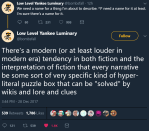
We need a name for a thing I’m about to describe. *I* need a name for it at least. I’m sure there’s a name for it.
There’s a modern (or at least louder in modern era) tendency in both fiction and the interpretation of fiction that every narrative be some sort of very specific kind of hyper-literal puzzle box that can be “solved” by wiki and lore and clues
and that this is in fact the goal of fiction, to create such a thing, the raw materials for this after-the-fact puzzle solving.
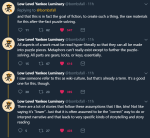
All aspects of a work must be read hyper-literally so that they can all be made into puzzle pieces. Metaphors can’t really exist except to further the puzzle-solving. All parts are gears, locks, or keys, essentially.
I saw someone refer to this as wiki-culture, but that’s already a term. It’s a good one for this, though.
There are a lot of stories that follow these assumptions that I like, btw! Not saying that it’s “lower”. Just that it is often assumed to be the “correct” way to do or interpret narrative and that leads to very specific kinds of storytelling and story reading
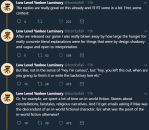
The replies on this are really great on this already and I’ll RT some in a bit. First, some context:
After we released our game I was really blown away by how large the hunger was for really concrete literal explanations for things that were by design shadowy and vague and open to interpretation.
But like, not in the sense of “hey I’m curious”, but “hey you left this out, when are you going to finish it or write the backstory lore etc”
Or, for example, we spent a lot of time on in-world fiction. Stories about constellations, fairytales, religious narratives. And I’d get emails asking if Mae was the descendant of an in-world fictional character. B/c what was the point of the in-world fiction otherwise?
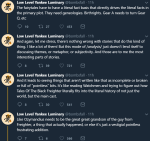
The fairytales have to have a literal fact basis that directly drives the literal facts in the primary plot. They need genealogies. Birthrights. Gear A needs to turn Gear Q, etc.
And again, let me stress, there’s nothing wrong with stories that do this kind of thing. I like a lot of them! But this mode of /analysis/ just doesn’t lend itself to discussing themes, or metaphor, or subjectivity. And those are to me the most interesting parts of stories.
And it leads to seeing things that aren’t written like that as incomplete or broken or full of “pointless” bits. It’s like reading Watchmen and trying to figure out how Tales of the Black Freighter literally fits into the literal history of not just the world, but the main cast.
Like Ozymandius needs to be the great great grandson of the guy from Freighter, a thing that actually happened, or else it’s just a vestigial pointless frustrating addition.
 🍓🧀 (archive)