Child Refugees Sent To A Tiny Pacific Island Are Becoming Unconscious From Their Trauma

quoms:

iamoutofideas:

realmoths:

Sorry to link to buzzfeed but i want peter dutton’s head on a pike

should note that nauru banned facebook because refugees were using it m to spread awareness

Dr Nick Kowalenko, who chairs the Child and Adolescent Psychiatry international relations subcommittee at the Royal Australian and New Zealand College of Child Psychiatrists, said that environmental features of pervasive refusal syndrome – including trauma, parental mental illness, and a pervading sense of hopelessness – have been the reality for years for the kids on Nauru.

“People can endure difficulties if there’s an anticipated hopeful outcome, a light at the end of the tunnel,” Kowalenko said. “But the dawning experience on a lot of those families and kids is that’s not the case.”

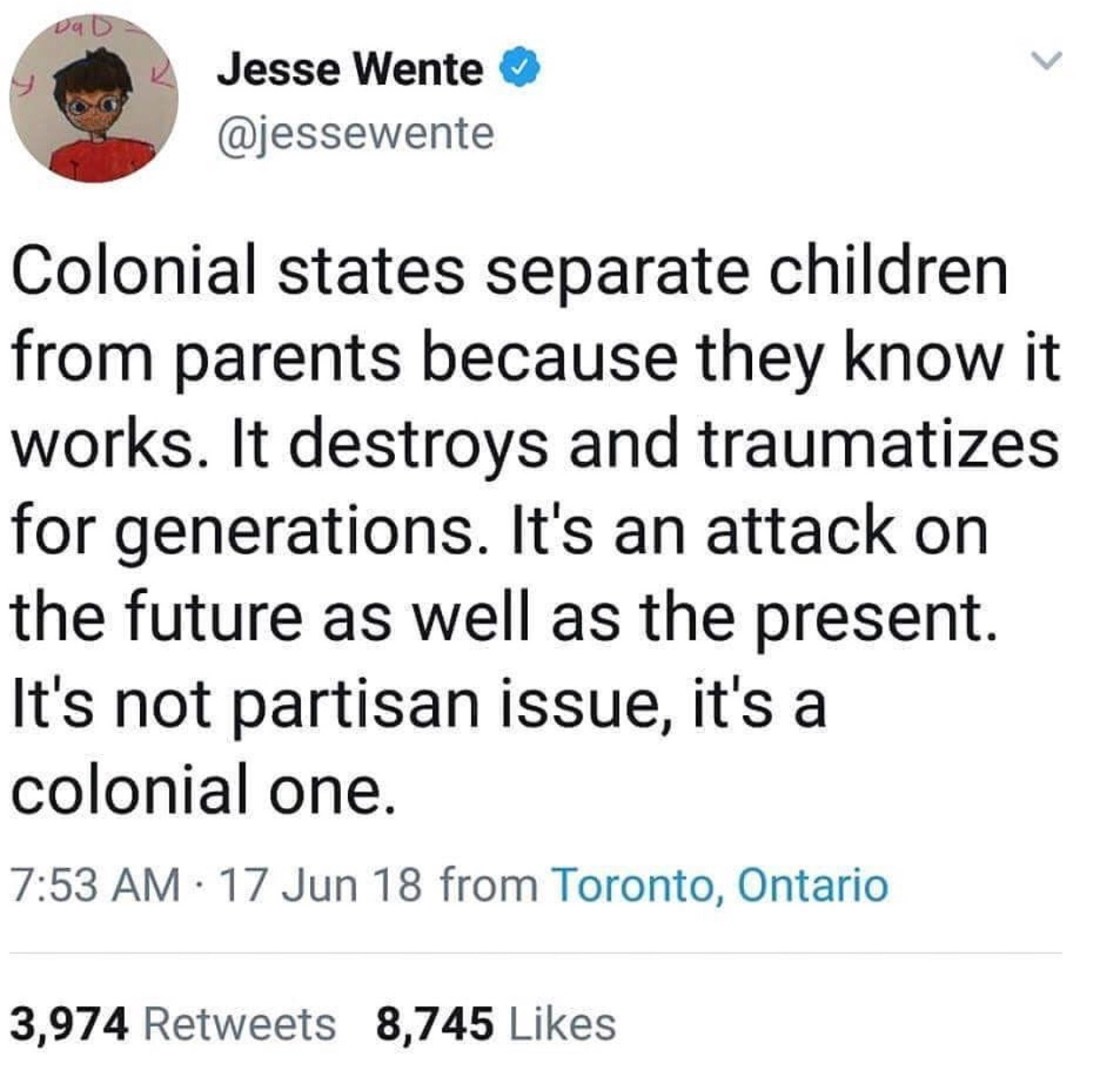
the explicit point of australia’s immigration policy, the explicit point of the way the detention centers on nauru and manus island have been run, is to provoke a sense of hopelessness. the trauma being done to these children is not even an accidental byproduct of conditions at the camps: it is an intended and inevitable consequence of the way the system is run, because it is a system designed to traumatise, regardless of the number of euphemisms deployed to design that fact

the stories in this article are proof positive that the people running australia’s immigration system are doing so competently and effectively

Child Refugees Sent To A Tiny Pacific Island Are Becoming Unconscious From Their Trauma

thescouring:

“Being able to feel safe with other people is probably the single most important aspect of mental health; safe connections are fundamental to meaningful and satisfying lives. Numerous studies of disaster response around the globe have shown that social support is the most powerful protection against becoming overwhelmed by stress and trauma.

Social support is not the same as merely being in the presence of others. The critical issue is reciprocity: being truly heard and seen by the people around us, feeling that we are held in someone else’s mind and heart. For our physiology to calm down, heal, and grow we need a visceral feeling of safety. “

– Bessel A. van der Kolk, The Body Keeps the Score: Brain, Mind, and Body in the Healing of Trauma

newvagabond:

infiniteragequit:

sothisistherapy:

ericfvckingharris:

Growing up in an abusive household is a fucking trip dude……If you’ve never had someone angrily wash a dish at you or fold a sock in your direction then how are you gonna understand why I get nervous when you quietly do the laundry, or why I ask “are you mad at me?” when you set the bag of groceries down too hard? It’s a totally different way of living and it impacts you long after you’ve left the situation.

This is so important.

Abused kids speak a language you can’t learn

My heart races when I hear someone sigh and then the adrenaline takes forever to wear off. I hate having these reactions even when I know I am safe.

We Can’t Keep Treating Anxiety From Complex Trauma the Same Way We Treat Generalized Anxiety

invisibledisabilitychameleon:

rapeculturerealities:

I’ve been living with the effects of complex trauma for a long time, but for many years, I didn’t know what it was. Off and on throughout my life, I’ve struggled with what I thought was anxiety and depression. Or rather, In addition to being traumatized, I was anxious and depressed.

Regardless of the difference, no condition should ever be minimized. If you are feeling anxious or depressed, it’s important and urgent to find the right support for you. No one gets a prize for “worst” depression, anxiety, trauma or any other combination of terrible things to deal with, and no one should suffer alone. With that in mind, there is a difference between what someone who has Complex PTSD feels and what someone with generalized anxiety or mild to moderate depression feels.

For someone dealing with complex trauma, the anxiety they feel does not come from some mysterious unknown source or obsessing about what could happen. For many, the anxiety they feel is not rational. General anxiety can often be calmed with grounding techniques and reminders of what is real and true. Mindfulness techniques can help. Even when they feel disconnected, anxious people can often acknowledge they are loved and supported by others.

For those who have experienced trauma, anxiety comes from an automatic physiological response to what has actually, already happened. The brain and body have already lived through “worst case scenario” situations, know what it feels like and are hell-bent on never going back there again. The fight/flight/ freeze response goes into overdrive. It’s like living with a fire alarm that goes off at random intervals 24 hours a day. It is extremely difficult for the rational brain to be convinced “that won’t happen,” because it already knows that it has happened, and it was horrific.

Those living with generalized anxiety often live in fear of the future. Those with complex trauma fear the future because of the past.

The remedy for both anxiety and trauma is to pull one’s awareness back into the present. For a traumatized person who has experienced abuse, there are a variety of factors that make this difficult. First and foremost, a traumatized person must be living in a situation which is 100 percent safe before they can even begin to process the tsunami of anger, grief and despair that has been locked inside of them, causing their hypervigilance and other anxious symptoms. That usually means no one who abused them or enabled abuse in the past can be allowed to take up space in their life. It also means eliminating any other people who mirror the same abusive or enabling patterns.

Unfortunately for many, creating a 100 percent abuser-free environment is not possible, even for those who set up good boundaries and are wary of the signs. That means that being present in the moment for a complex trauma survivor is not fail-proof, especially in a stressful event. They can be triggered into an emotional flashback by anything in their present environment.

It is possible (and likely) that someone suffering from the effects of complex trauma is also feeling anxious and depressed, but there is a difference to the root cause. Many effective strategies that treat anxiety and depression don’t work for trauma survivors. Meditation and mindfulness techniques that make one more aware of their environment sometimes can produce an opposite effect on a trauma survivor.  Trauma survivors often don’t need more awareness. They need to feel safe and secure in spite of what their awareness is telling them.

At the first sign of anxiety or depression, traumatized people will spiral into toxic shame. Depending on the wounding messages they received from their abusers, they will not only feel the effects of anxiety and depression, but also a deep shame for being “defective” or “not good enough.” Many survivors were emotionally and/or physically abandoned, and have a deep rooted knowledge of the fact that they were insufficiently loved. They live with a constant reminder that their brains and bodies were deprived of a basic human right. Even present-day situations where they are receiving love from a safe person can trigger the awareness and subsequent grief of knowing how unloved they were by comparison.

Anxiety and depression are considered commonplace, but I suspect many of those who consider themselves anxious or depressed are actually experiencing the fallout of trauma. Most therapists are not well trained to handle trauma, especially the complex kind that stems from prolonged exposure to abuse. Unless they are specially certified, they might have had a few hours in graduate school on Cluster B personality disorders, and even fewer hours on helping their survivors. Many survivors of complex trauma are often misdiagnosed as having borderline personality disorder (BPD) or bipolar disorder. Anyone who has sought treatment for generalized anxiety or depression owes themselves a deeper look at whether trauma plays a role.

damn, this is important!

We Can’t Keep Treating Anxiety From Complex Trauma the Same Way We Treat Generalized Anxiety

c0rpseductor:

honestly like

knowing so many people who have been through really unspeakable horrible things and having a few bad things in my own past too, i think there’s nothing that is more commendable for a traumatized person than, like, being able to just….live and grow

so many people assume “oh if you don’t get a job/get married/go to school/etc youre not successful” but for a lot of people it’s an incredible fight just to keep going every single day and i’m really proud of those people for keeping on no matter how hard it’s gotten, because even if sometimes you take a few steps back you keep going forward on that path

even if you do nothing but like eat chips and play video games, for fucks sake youre not dead, and a lot of people seem to forget that, like, that can be an achievement in and of itself.

i dont want to say like “just give up on doing things like going to school” because it’s important to do those things if/when it’s possible for you, but if all you can do is take care of your health and keep fighting, then it’s something you should be proud of! so many people will try to drill into your head that if you’re not Being Productive nothing you do matters but if you’re just fighting to stay afloat then it’s in your best interest to focus on that and be happy with yourself for keeping your head above water

literally so many people would never be able to walk a mile in your shoes, so remember that next time someone gives you shit for having a hard time. they probably couldn’t go through what you have.

fangirlinginleatherboots:

“but this didnt used to trigger you” or even “this didnt used to trigger me why am i upset about it now, i must be faking” 

  • memory shifts. you build barriers to protect yourself and depending on the frequency of your exposure to something, those barriers can break down or change
  • understanding something better can make it feel worse sometimes. look, when you were younger you probably couldnt understand that something was hurting you. now that you know it was bad??? yeah its gonna trigger you worse than it used to because you KNOW now.
  • recovering from some things can unlock deeper struggles. so you dealt with the issues that were on the surface? well your brain is going to let you access the next level of problems that need to be dealt with now.
  • life has different phases that expose you to different triggers. stuff that triggers a teen with school responsibilities is going to be different than the stuff that triggers a new parent with a new baby or an adult with a social job or a blogger with constant exposure to daily news.
  • triggers can be shaped by the trauma of people you know. you can gain new triggers from knowing something related to that happened to someone you care about. once you know how awful a thing can be, even if it wasnt awful for you personally, you can still be sensitive to it.

and most importantly

  • YOU DONT NEED A REASON FOR SOMETHING TO BE A TRIGGER. yes, there IS a reason, but it’s not your responsibility to immediately understand why your brain does what it does. forcing yourself to analyze too soon is skipping the stage where you learn to cope with it first. learn to cope, then analyze. knowing why is difficult if you cant handle the emotions that come with knowing
  • UNDERSTANDING COMES WITH TIME AND INTROSPECTION. you should not force yourself to explain your triggers, especially without the guidance of a therapist or trusted, stable confidant.

creepycrawlycrazies:

you’re not stealing from “real” abuse victims if you’ve been bullied
you’re not faking or invading the community if your friend was your abuser
you’re not weak for being traumatized by “just” bullying

if you were bullied, your abuse was real abuse, you have the right to call your abusers what they are, your abuse and trauma isn’t lesser, and you’re strong for surviving everything you did. keep on going. i’m here for you.