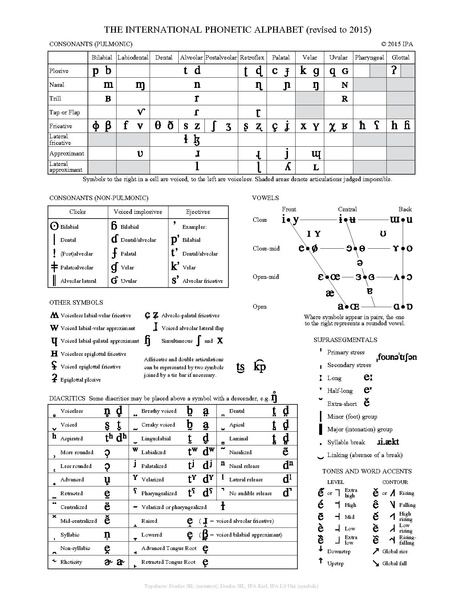
I present to you the
International Phonetic Alphabet (IPA). ( IPA website)
Basically this here is the cheat code for all pronunciation of every language
E v e r y. L a n g u a g e.
How?? Well, each symbol corresponds to one sound.
The table shows you where the sound is located and what your tongue has to do to pronounce that sound.
Example:
æ is said at the back of your throat while your throat is around halfway closed (indicated by its location relative to the words “open” and “front). This sound is found in
“back“ (in the Standard/General American dialect).
ŋ
is said by touching the base of your tongue to where the roof of your mouth gets soft (the velum) and exhaling through your noise while making noise (indicated by “velar” and “nasal”). This sound is found “song”.
As you can see, “ng” in “song” is made up of two letters that have different sounds while separate, but together they make a different sound. And English has some letters that correspond to several sounds all on their own! This is the case on many other languages, and trips up a lot of foreign language learners.
IPA ELIMINATES THIS DIFFICULTY BECAUSE EACH SYMBOL = 1 SOUND
lol sorry for all caps but im excited and this is important so
But how will this actually help you? Because dictionaries are amazing.
See that? That’s the entry for “language” in my Korean-English dictionary
(edited bc the previous picture had a pseudo-IPA and my sleep-deprived brain didn’t realize it until @korean-with-jangmi and
@gaybluecolson
pointed it out).
language -> ‘læŋgwɪdʒ
Pretty cool, right?
Here are some examples of IPA in action in different languages:
French: deux -> /dø/
Korean: 내가 -> /nɛ-ɡa/ or /ne-ga/
Afrikaans: seun -> /sɪøn/
Standard Arabic: عَيْن -> /ʕajn/
Ready to try this out for your own?
If you just want to only know how to pronounce your target language’s sounds:
Learn how to say the sounds in your TL by understanding the column/row titles that they are in on the IPA chart
(consonants here and vowels here)
Optional (or if you don’t have a dictionary):
Get the IPA charts for your target language (usually on its wikipedia page at “_target language_ Phonology”. If it’s not there then look up “_target
language_ IPA transcription”)
Example of IPA consonant and vowel charts (Afrikaans):
It’s a lot less intimidating when it’s the sounds for only one language, right?
REMEMBER: you don’t need to be able to pronounce every sound in IPA to make use of this chart, just know how to make them and what these symbols sound like (more or less) and your life of learning pronunciation will be so much easier
So there you have it:
The Secret to Perfect Pronunication in Any Language
Go, be free my language-learning friends, go pronounce things like natives!
and get rid of that nasty romanization for all my fellow korean learners
(oh
and if anyone has any questions about this, send em my way! i know
there are a couple linguistics blogs that follow me so if any of yall
wanna add smth, plz do!)
yall better reblog the heck outta this bc my hard work CANNOT go wasted ok?? i’ve been researching/writing/revising this for idk how long and my head hurts really bad asjdfsdg help



 🍓🧀 (archive)