trans girl / physically disabled / ace inclusionist uwu / tag discussion of trans deaths and disabled deaths and alcohol thanks
Author: peasantchick
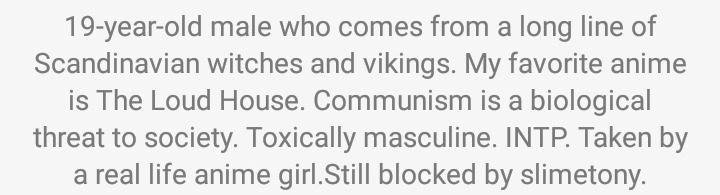
[id: a tumblr bio. “19-year-old male who comes from a long line of Scandinavian witches and vikings. My favorite anime is The Loud House. Communism is a biological threat to society. Toxically masculine. INTP. Taken by a real life anime girl.Still blocked by slimetony.]
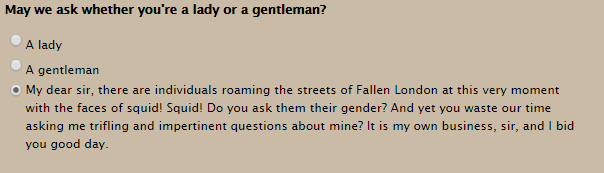
This is officially the best gender choice in a game ever.
[caption: screenshot from a text-based game that has the question “may we ask whether you’re a lady or a gentleman?” with the responses:
a lady
a gentleman
my dear sir, there are individuals roaming the streets of fallen london at this very moment with the faces of squid. squid! do you ask them their gender? and yet you waste our time asking me trifling and impertinent questions about mine. it is my own business, sir, and i bid you good day.
vulcan naming conventions are inconsistent, but the surakian tradition is generally two-syllable names, men’s s____k, women’s t’p___. so, yeah, t’pose is a completely reasonable english transliteration of a traditional vulcan woman’s name
to expand on this a little, the original memos actually say that vulcan mens’ names should be five letters, s???k. this is where you get “shrek is a vulcan name” discourse.
however, that doesn’t really scan. vulcan names aren’t meant to be written with the latin alphabet, after all, and vulcan script looks like this —
— if you can find anything that’s clearly a letter here, never mind delineating five of them, you’re a better man than me.
rather, i’d like to suggest the typical transliteration of a vulcan man’s personal name will most likely fit a {C}CVC.vc format, transliterated S[VC.v]k, assuming a traditionally minded family as well as modernity not fucking with pronunciation too much—remember young diot coke, born 1379? her name written today would probably be denise cook.
assume for a moment that surak is a good example of a traditional name; sarek, then, is uncorrupted in modernity. [ˌsʊɹˈʌk] and [ˌsaɹˈɛk], i guess? ipa will be the death of me one day and i’m absolute shit at vowels. but both of these names are S[VC.v]k, if you’ll accept some very ad hoc use of standard symbols.
there are names that don’t fit this model, though. spock; tuvok; stonn. we’ll throw shrek in here too.
tuvok is the easiest one to consolidate, of course: CCVC.vc, and the name [ˌstʊvˈɑk] drops its /s/ over time to simply [ˌtʊvˈɑk]
spock, stonn, and shrek are single-syllable, five-letter romanizations. immediately a problem becomes apparent, though; spock’s romanized /ck/ is the same as what is elsewhere romanized simply /k/ — the generalization of {C}CVC.vc as “five letters” throws off what would otherwise be romanized as “spok”; similarly, stonn is… presumably not displaying gemination, as romanizations typically drop it (see óðinn -> odin or the names of the dwarves in lotr for examples of consonant reduplication denoting gemination being dropped); as such we should probably see his name romanized as “ston”.
spock and stonn, normalized as spok and ston, are both CCVC. shrek is CCVC as well; remember /sh/ is /ʃ/ in ipa. so you have, in order, [spɑk], [stɑn], and [ʃɹɛk].
i would argue that spock and shrek are names which, over time, experienced vowel reduction; they’re not invalid names, they simply aren’t the original forms of them. diot and denise.
spock, then, would be derived from the name [ˌsʊpˈɑk]. the vowel loses prominence until it’s no longer pronounced at all, or only barely pronounced.
possibly this is due to a slight complication of the guidelines; not simply {C}CVC.vc, but {C}C’VC.vc. that is, not [ˌsʊɹˈʌk] but [ˌs’ʊɹˈʌk]; not [ˌsaɹˈɛk] but [ˌs’aɹˈɛk]. [ˌst’ʊvˈɑk] becomes [ˌt’ʊvˈɑk]*, and spock maybe originally was [ˌs’ʊpˈɑk].
see, /p/ really loves turning into /p’/; it probably happens in your speech all the time. so [ˌs’ʊpˈɑk] maybe gets functionally pronounced as [ˌs’ʊp’ˈɑk], and that’s a lot of ejectives in one syllable, so down the line it becomes simply [sp’ɑk].
shrek experiences a similar, but not identical, vowel reduction, with the likely protoform [ˌʃ’ʊɹˈɛk] becoming [ʃ’ɹɛk].
stonn is a bit of an odd case, obviously, as it doesn’t end in /k/ at all. i might argue that it’s diminuitive; like naming your kid joe or joey instead of joseph, you might name your kid [st’ɑn] instead of [ˌst’ɑnˈɛk]. this may be especially common if it’s typical vulcan pronunciation is actually [st’ɑŋ] and indicative of a dialect shifting word-final /k/ to /ŋ/; in a dialect where [ˌst’ɑŋˈɛk] is being pronounced [ˌst’ɑŋˈɛŋ] anyway, fuck your _# /ŋ/, who needs it? thus, stonn still feels complete as a name despite technically being a diminuitive.
*note that ipa /t’/ and the element /t’/ in traditional vulcan women’s names are not the same thing; /t’/ designates what in ipa is written /tʔ/ or /t’ʔ/. t’pose is [tʔpoʊz] or [t’ʔpoʊz] and, structurally, i suppose, C.CCVC, where women’s names are likely constructed C.CC{C}V{_C}; that is, T’P[{C}V{_C}], allowing t’pau ([t’ʔpaʊ]), t’pring ([t’ʔpɹɪŋ]), t’pose ([t’ʔpoʊz]).
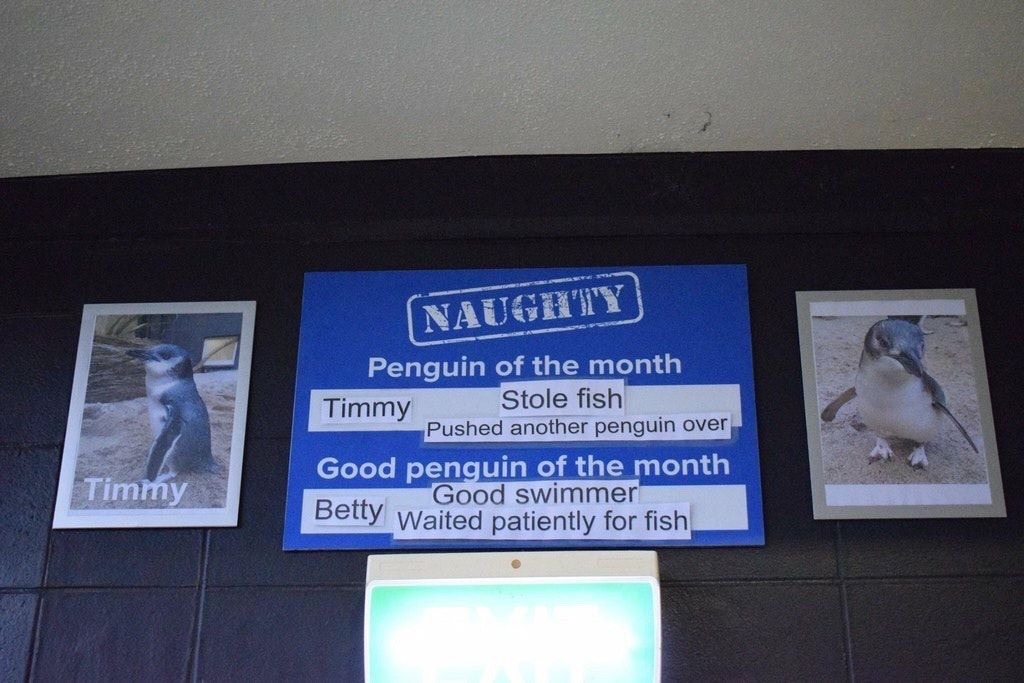
[Description: Three pictures on the wall of a zoo enclosure. On the left, a penguin called Timmy. On the right, another penguin called Betty. In the middle poster the text: “NAUGHTY penguin of the month: Timmy. Stole fish, pushed another penguin over”. Under that: “Good penguin of the month: Betty. Good swimmer, waited patiently for fish.”]
many an edgelord has observed that morality is purely a human creation, and has thus concluded that it must be fake, and lame, etc.
this, of course, misses the whole point- morality is social technology.
imagine a prehistoric community of hunter-gatherers. they’re doing decently for themselves but they have a problem- conflicts in the community keep escalating to violence, even killing. so a moral edict is created- “do not spill blood”- and people following this edict helps to keep conflicts from spiraling out of control, increasing the overall welfare of the community. decades go by, and with the help of the social technology of morality, the hunter-gather community has settled down, developed agriculture, and formed a small early city.
then someone in the community figures out how to drain poison from snakebites, or some other early form of surgery- and a problem emerges, because according to the moral edict, this practice is banned, since it spills blood.
so an underground develops, of people using these banned practices. and the society struggles to stamp this out, and the underground surgeons struggle against this repression- until as a result of the struggle, it is realized that the moral edict is flawed, and is preventing well-being, rather than encouraging it. so the moral edict is revised to “do not spill blood involuntarily,” legalizing surgery, and further improving the well-being of the community.
through this process- a dialectic between hegemony and counter-hegemony, an alchemical process of the conjunction of opposites- the social technology of morality is refined and improved.
both moral realism and moral nihilism stymie this process. we must not fall into the trap of thinking morality is One Definite Unchanging Thing. and we also must not fall into the trap of thinking morality is Fake And Lame And Nothing Matters.
we must remember that morality is social technology, which must be continually revised and rectified, through a repeating process of revolutionary struggle.
Human Morality as the Operating System for the Computer that is Mankind: makes it easier to function understandably, but does best when we upgrade it every so often.


 🍓🧀 (archive)