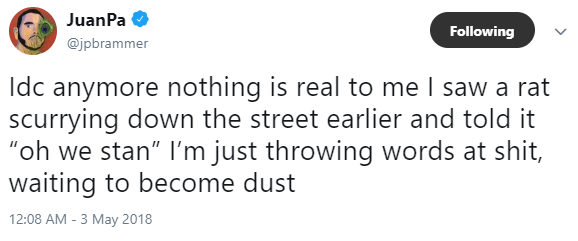
[Caption: A tweet from JuanPa (@jpbrammer), which reads, “Idc anymore nothing is real to me I saw a rat scurrying down the street earlier and told it ‘oh we stan’ I’m just throwing words at shit, waiting to become dust”]
[image: a quote tweet. @ DineshDSouza, quoted: Fake sexual assault victims. Fake refugees. Now fake mail bombs. We are all learning how the media left are masters of distortion, deflection, & deception @ Hbomberguy: Note that as Conservatives get what they want, their paranoia only increases – despite coming up two full years of government control, the ideas they support don’t seem to be making anything better. So these failures must be attributed to an ever-powerful ‘media left’ control.]
Personally I always felt like Hobbits age at roughly the same rate as exceptionally healthy humans and that the reason they don’t come of legal age until 33 is because have you met people in their 20s because Tolkien did
Funny: Pippin is an idiot because he’s not an adult yet.
Funnier: Pippin is an idiot because he’s 28.
i guess, i would like
to be loved
to not be a chore
for my life to feel like it has some kind of point to it
“if it’s not plot relevant, cut it!!” is such awful writing advice
if JRR Tolkien had cut every bit of Lord of the Rings that wasn’t directly related to the central plot, it would have been just one book long, COLOURLESS and DULL AS DIRT.
all the little worldbuilding/character details are what draw you in and give the central plot weight, FOOL
The plot is not the same thing as the story. The plot is the mechanics of how one thing causes another.
Some classic stories have no plot to speak of – the characters just wander from one situation to the next. Alice in Wonderland and The Wizard of Oz are examples.
Some stories have partial plots, where some things in the story cause other things, but other things come out of the blue and pass away without consequence. This category includes classics too: Huckleberry Finn, The Wind in the Willows.
Even in stories with a strong plot, sometimes the most iconic moments fall outside that plot. Think of the No-Man’s-Land scene in Wonder Woman or the dying dinosaur in Jurassic World II.
Ah, but those aren’t classics, I hear someone say. Well, I disagree in the case of Wonder Woman (although time will tell), but let’s go right to the top of the English canon, Shakespeare’s Hamlet.
What’s the most iconic scene, if you had to pick one to illustrate for the front cover or the playbill poster? Ninety-nine times out of a hundred, it’s the Yorick skull scene. What does that have to do with the plot? Precious little. It’s just a way to keep Hamlet busy until Ophelia’s funeral arrives. And even there it’s not very well fit for purpose, because it doesn’t explain why Hamlet is hanging around in a graveyard anyway.
That’s because, tight though the plot of Hamlet is, the story of Hamlet is not reducible to its plot. Hamlet is a three-hour exploration of death and skulls and murder and corpses and funerals and ghosts and “what dreams may come”. The plot is just there to drive you around between the features of that mental landscape.
So the question isn’t “Does this serve the plot?” The question is “Does this help explore the idea that the story is about?”
(Why yes, I have written all this somewhere before.)
One really helpful thing I learned- and I can’t remember if it was from a writing class or a lit class, so I don’t even who to thank for it- is that each scene should move at least two or three aspects of what you’re writing forward.
That can be plot. It can be story.
It can be worldbuilding. It can be theme. It can be character. It can be relationships. It can be any number of things, but it needs to be more than one.
If a scene does nothing but move plot forward, it’s not accomplishing enough to earn its real estate on the page, any more than a scene that just builds character does.
When I look at it not as prioritizing plot, but as not prioritizing any one aspect of the story above all others, it makes it easier for me to figure out what strengthens my writing and what doesn’t, or,at the very least, how to make a scene that’s important to me more useful to the story as a whole.
One thing I remember from my Poetry course specifically was that you should try to recite it back to yourself, and any parts you couldn’t remember well you should consider rewording, because if they didn’t stick in YOUR head as the person who wrote them (and rewrote them, and puzzled over them, and rewrote them again…), they likely weren’t gonna stick in someone else’s head.
This doesn’t work as well for prose pieces longer than a short story obviously, although I guess it depends on the individual person and the individual piece.
For the plot aspect, maybe try to do a quick outline from memory of what happens in the piece (at least in your latest draft) and see if there’s anything you can’t remember clearly or explain in a couple short bullet points.
For the prose aspect, maybe take a section or chapter and try writing or typing it out from memory. Even just a difficult paragraph or passage. Anywhere your brain gets stuck or keeps trying to switch the words around probably needs rewording or deleting.
Worldbuilding…idk, maybe try, without checking your notes, to write out a historical timeline, draw a map, and/or make a list of important characters and places. Anything you might include with the piece or put on a website about it to help readers keep track of everything. Rules of magic, family trees, etc. You might notice stuff that’s confusing (like characters whose names start with the same letter SORRY THAT’S JUST A PET PEEVE AND ALWAYS THROWS ME OFF NEVER HAVE BOTH A MATT AND A MARK AT THE SAME TIME I’M BEGGING YOU) or you might notice places where you’ve neglected info. Maybe take some element (person, place, event, language, song, idk) and list from memory a few ways that element is important/relevant to the world, and which other elements it relates to?
Idk for all the Tolkien I read, worldbuilding isn’t my specialty. You do you I guess.
Consider taking a couple days off working on your piece (mb work on another piece to keep up your work ethic tho) before doing this, so it’s not all fresh in your head. That’s a good thing to do every now and then before an editing session anyway, so you can see it with fresh eyes.
Ofc this is all just spitballing to take that advice from poetry and expand it to prose. Shrug!



 🍓🧀 (archive)