i mean, maybe this is my inner “survivor of child abuse” talking, but I am not going to tell abusive parents that they’re bad at bringing up their children without a bullet proof plan with regards to how I could protect my student from the emotional and physical backlash of that meeting.
Important thing to remember about intervening in abuse in general. Any actions taken by others to hold the abuser accountable WILL be taken out on the victim and not the person doing the confronting. Do not confront an abuser about their actions unless you know for absolute certain that you can protect their victim from the fallout.
It’s odd how there’s a network of forums that are effectively forums for abusive parents, even though they wouldn’t accept that label, although it probably comes down to bad driving out good more effectively than the reverse. She mentions in one of the posts that people who are estranged from their children through no fault of their own occasionally show up, but they don’t stick around.
twelve months on the parallels with incel culture are obvious.
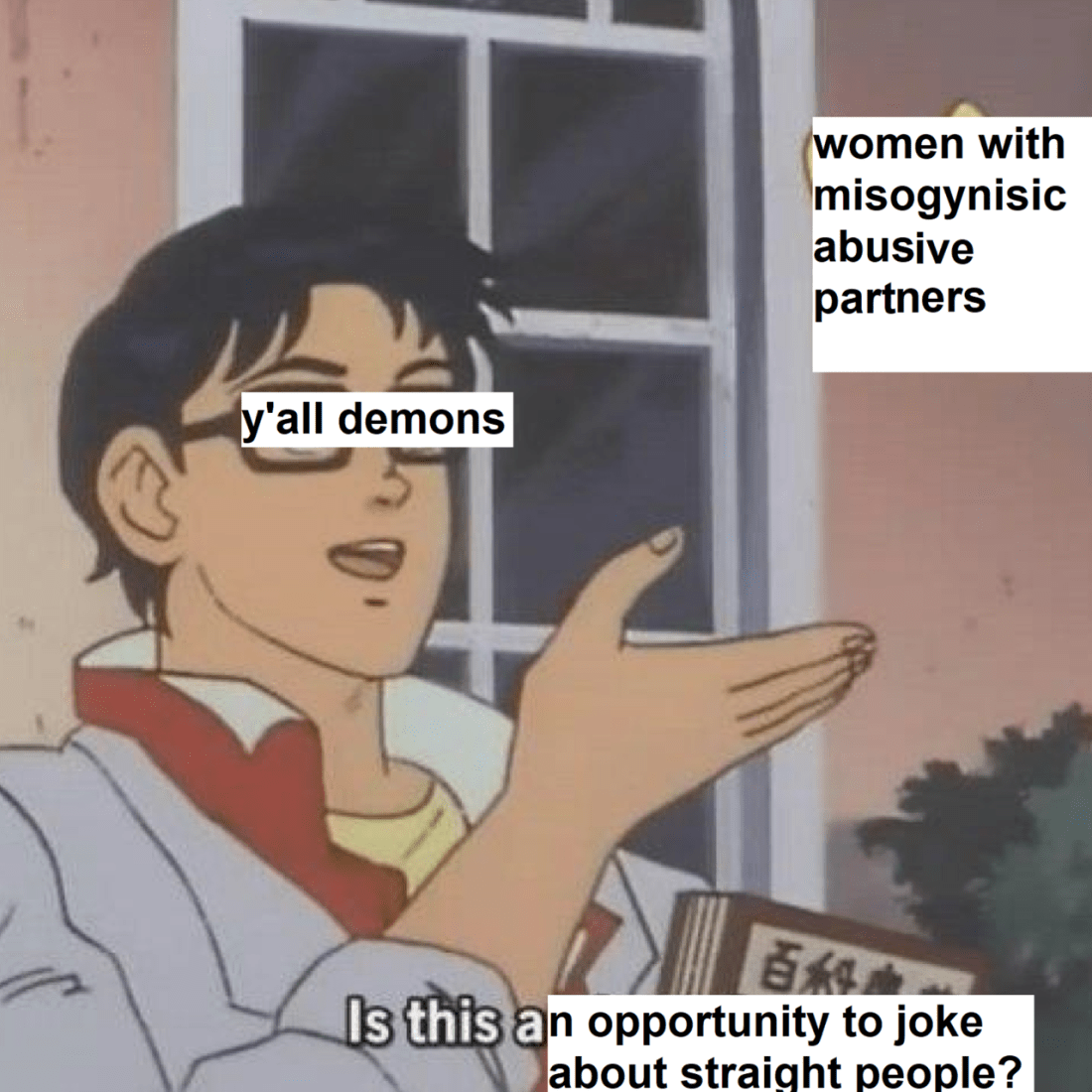
[image description: an is this a pigeon meme. the words “y’all demons” are edited over the man’s eyes, the words “women with misogynistic abusive partners” edited over the butterfly he’s gesturing at, and the words “is this an opportunity to joke about straight people?” edited over his question. the second image which was added through a reblog, is a screenshot of what someone else had tagged the post when they re-blogged it. it reads: “in our defense…….many know they’re abusive and could safely leave but refuse because they just don’t want to be single. and they say ‘i don’t have to be in a relationship to be happy’ but still refuse to leave.” the image that follows is the same version of the meme above, but the man is instead edited to say “is this her fault somehow?” end of image description.]
graphic on screen torture of a woman is not provocative not metaphorical not deep women have made art and film about pain and sacrifice without falling back on a gross-out contest its not entertaining to see that its not compelling its actually one of the most tired things present in film today
men’s loyalty to violence is disturbing. when women want a life free of abuse, assault, threat, & coercion, men’s first suggestion is “learn to fight back. learn to defend yourself”. i don’t want my life to be a fight. i don’t want to “prove myself” through inflicting pain & fear.
i don’t find violence and physical conflict fulfilling or self-actualising.
“Emotional abuse works like this: You are screamed at, and then, not knowing any better, you stand up for yourself. You think this is a way of being strong. You think this is a defense tactic.But this only provokes more screaming. Going silent provokes more screaming too, but usually it keeps the threats to the minimum. It keeps it just at screaming and not: a shove down the stairs, or order to pack your stuff and get out. So you learn how to go silent. How to play dead. How to cry without making a noise. How to swallow noise. How to wipe your cheeks, get out of the car, and go about your day. You learn. And when the screaming has stopped, when the two of you are in the car or out to dinner and they’re all smiles, all asking for favors, all questions, you are still hurt and annoyed and want to ask them, how? How can you speak to me like that? How can you pretend you did not say those things? How can you have forgotten? But you’ve learned. So you listen to, “Can I borrow your key”s and “how was your day”s and you play dead. You swallow the noise. And sometimes it doesn’t matter who is speaking to you, it doesn’t matter if they’re a friend, it doesn’t matter if their criticism is constructive, it doesn’t matter. You’ve learned. Any sort of speaking, any raising of the voice, any insult and you play dead.”
“but this didnt used to trigger you” or even “this didnt used to trigger me why am i upset about it now, i must be faking”
memory shifts. you build barriers to protect yourself and depending on the frequency of your exposure to something, those barriers can break down or change
understanding something better can make it feel worse sometimes. look, when you were younger you probably couldnt understand that something was hurting you. now that you know it was bad??? yeah its gonna trigger you worse than it used to because you KNOW now.
recovering from some things can unlock deeper struggles. so you dealt with the issues that were on the surface? well your brain is going to let you access the next level of problems that need to be dealt with now.
life has different phases that expose you to different triggers. stuff that triggers a teen with school responsibilities is going to be different than the stuff that triggers a new parent with a new baby or an adult with a social job or a blogger with constant exposure to daily news.
triggers can be shaped by the trauma of people you know. you can gain new triggers from knowing something related to that happened to someone you care about. once you know how awful a thing can be, even if it wasnt awful for you personally, you can still be sensitive to it.
and most importantly
YOU DONT NEED A REASON FOR SOMETHING TO BE A TRIGGER. yes, there IS a reason, but it’s not your responsibility to immediately understand why your brain does what it does. forcing yourself to analyze too soon is skipping the stage where you learn to cope with it first. learn to cope, then analyze. knowing why is difficult if you cant handle the emotions that come with knowing
UNDERSTANDING COMES WITH TIME AND INTROSPECTION. you should not force yourself to explain your triggers, especially without the guidance of a therapist or trusted, stable confidant.
Somewhere I read that a symptom of autism/ ASD is a tendency to feel victimized. Feel. And I couldn’t get that out of my head because there is a difference between just saying that and saying “a tendency to be” victimized. Saying “feel” carries the implication that the victimization is in one’s head.
But in any case, there’s probably a reason people with ASD feel victimized:
Fight is when the adrenaline surge helps you kick the shit out of whatever is threatening you. In an “animal attack” sense, it means beating up a wolf or whatever. In a modern interpersonal sense, it tends to mean “screaming at your boss until you get fired.” That said, even a confrontation as simple as saying “no” to an abuser is a type of fight response. Anything where you set and defend boundaries is fighting, in this context.
Flight is when the adrenaline surge helps you run away. Whether this means outrunning a wolf, or finding an excuse to leave the room and lock yourself in the bathroom where your angry parent can’t reach you.
Freeze is when you become immobilized by fear. If you’ve ever been so scared that your entire body locked up and you couldn’t even scream, that’s the freeze response. In an animal context, many predators have movement-prioritizing sight, and may overlook you if you seem like just another pattern of light through trees. In an interpersonal context, freeze tends not to be overly useful, though some abusers will stop attacking someone who doesn’t fight back. In either case, if a confrontation gets physical, highly contracted muscles are harder to hit, and provide some degree of pain reduction.
Flop is the opposite of freeze. Rather than overwhelming muscle contraction holding you still, it involves overwhelming muscle relaxation. Fainting, playing dead, etc are all “flop” responses. The stereotype of urinating due to fear is because of involuntary muscle relaxation, and is also a flop response.
Friend is actually one of the first things human beings learn to do when faced with a threat. It’s the thing babies tend to do when they scream for an adult to help them. It involves trying to get the attacker “on your side,” whether by using baby talk and some treats at that wolf, or agreeing with everything your aggressive partner says in the hopes of satisfying them and getting them to leave you alone. Begging for mercy, becoming extremely submissive and agreeable, laughing at everything your abuser says is if it is brilliant and hilarious rather than a real threat, complimenting them, doing everything they say. These are “friend” behaviours.
Because “friend” is the first thing we as human beings learn, and because we are such social creatures who rely on befriending each other constantly, it is most people’s go to response to human-centered fear. Our brains are built from day one to see compromise and collective action as the “right” solutions to problems.
This, unfortunately, also makes it very, very, very easy for abusers to train their victims into being extremely obedient, and into doing things that the victims would not normally do.
The prevalence of this kind of fear response is why cults operate the way they operate. It’s why people in abusive situations are rarely able to leave them until they get outside impetus. It’s why people love shitheel cops who can and would kill them without a second glance. It’s why brown nosers and teachers’ pets exist.
Human beings are built to make friends, so much so that we rely on that skill in most confrontations.
And that makes us easily exploited by anyone who doesn’t see us are friends, but rather, as fodder.
Minors, please be careful. I can’t stop you from using these memes. No one can. But be aware of who you use them with. If you make a joke of the like with an adult, and they reply pushing the “joke” further – it’s a big red flag. If an adult uses these memes with you, run. If possible, try avoiding using them with adults too – it’s not your responsibility, it’s true. But better safe than sorry.
This also stands between minors of different ages – a 13 year old is a minor. So is a 17 year old. Is it okay for a 17 year old to tell a 13 year old that they’ll be their (insert x/y/z alignement)? Absolutely not. Be mindful of your age gaps, be mindful of the differences in maturity between you. And stay safe.
This is okay to reblog, and I highly encourage it, especially from adults.



 🍓🧀 (archive)