some stupid ideas for dnd characters while i fight depression and boredom:
half elf, half tabaxi, full asshole
demon pretending to be a tiefling
doppelganger who took over someone’s life but had no idea they were an adventurer or into shady shit and is having a lot of trouble with trying to keep his identity up
some more:
monk that is DEFINITELY not saitama from opm but beefier
orc bard with low charisma and gets very nervous around cute people
someone who doesn’t have a tragic backstory. their parents are alive and well, they write to them all the time about their adventures, and their parents support their adventuring and send them things they might need
low intelligence wizard
low intelligence female barbarian whos just here for a good time
a cleric or warlock who’s married to their patron and very in love
warlock whose patron is their parent and they’re basically studying abroad on the human plane
a ranger whose companion is actually the ranger, but their bodies got switched
If you wanna use one of these lmk and send me updates on them
A human who’s from a family of tieflings. Someone in the family made a deal with a demon and the magic got weirded out so much it turned them human.
a druid who is just poison ivy, or dresses just like her
Dragonborn who look like crocodiles and speak with a southern accent
Shardmind or warforged who speaks like GLaDOS
Gunslinger dragonborn, but instead of using a gun, they shoot bullets from their mouth in a breath attack
A bard who uses an omatone
A timid human who looks like ur run of the mill wizard or librarian, but turns out to be a barbarian. All their rage comes from thinking about people who’ve bullied him or thinking about library late fees
#THESE ARE ALL VERY GOOD….. #CROCODILE DRAGONBORN ALTERNATIVE: A CROC DRAGONBORN WHO’S JUST STEVE IRWIN
you’re so fucking valid
Hey if u wanna send like $3 my way so I can see my gf for my 23rd birthday, I will make you a complete character sheet either using these concepts or completely from scratch, complete with a fully fleshed backstory, character flaws, and family tree. I l o v e worldbuilding.
For $6 I’ll make you an entire world for your campaign
Tag: dnd
tiny brain: playing a dragonborn to breathe fire
big brain: playing a dragonborn to be a member of a Proud Warrior Race like a fantasy klingon
galaxy brain: playing a dragonborn to lay eggs
interdimensional brain: playing any other race and still laying eggs because nothing in the books says you can’t
tiny brain: playing a dragonborn to breathe fire
big brain: playing a dragonborn to be a member of a Proud Warrior Race like a fantasy klingon
galaxy brain: playing a dragonborn to lay eggs
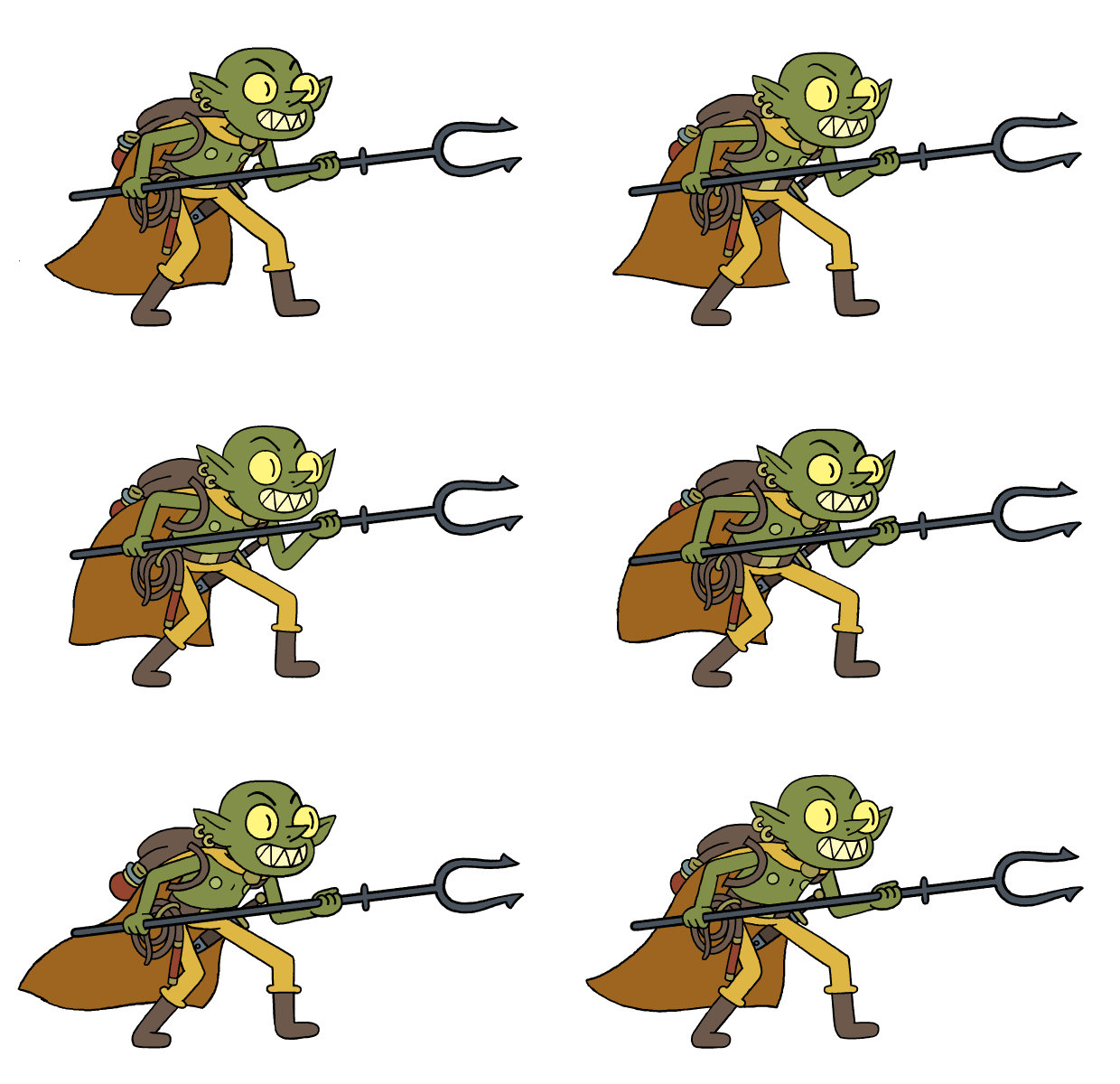
god so much of Wizards of the Coast’s writing for D&D is screwed over by the fact that they use the same creature type for “person” and “low-level intelligent enemy”
@bit-by-a-dead-bee essentially the thing is that orcs and kuo-toa and gnolls and stuff are intended to be tutelary monsters – orcs are gruumsh’s revenge for not being included with the other gods, kuo-toa are religious fanaticism gone off the deep end, gnolls are primal unchecked savagery, etc.
in game terms they’re humanoid solely because low-level spells only affect humanoids and those are the low-level enemies, but that type is also shared by low-level enemies who are meant to be monsters in the real-world sense – people, like elves and dwarves and humans, who’ve simply chosen evil on a personal level.
so the implication is that these tutelary monsters are as natural and as “people” as elves and dwarves and humans are, because they share the humanoid type, and since there isn’t a distinction in creature type, what the books end up saying is “certain kinds of people are monsters”
granted D&D says that you should make your own lore but it’s still fucked-up that this gets in the actual books
Hi. I reblogged this earlier (I’m not sure if the notification showed up since I deleted it, but I didn’t want to seem like I was trying to start something then run away when that isn’t the case). I deleted that post because I think I misunderstood what your point was in the original post I made and I apologize for that. Basically I thought your entire point was the classification was wrong because they were more monstrous than humanoid.
I’m a bit confused as to what your explanation is trying to convey. Is it that these creatures shouldn’t be classified as humanoid but rather something like goblinoid so that there’s a distinction between a “person” and a “monster?”
Something like that, yeah. The fifth edition Monster Manual says the following, emphasis mine:
Humanoids are the main peoples of the D&D world, both civilized and savage, including humans and a tremendous variety of other species. They have language and culture, few if any innate magical abilities (though most humanoids can learn spellcasting), and a bipedal form. The most common humanoid races are the ones most suitable as player characters: humans, dwarves, elves, and halflings. Almost as numerous but far more savage and brutal, and almost uniformly evil, are the races of goblinoids (goblins, hobgoblins, and bugbears), orcs, gnolls, lizardfolk, and kobolds.
The idea that there’s creatures that have culture yet are somehow almost uniformly evil has some very nasty real-world implications, especially when they’re the same type of creature as those that have culture and human capacity for good and evil. If you want goblins and orcs to be another kind of people (as I do, and the Eberron setting does), then it’s fine for them to have the same creature type as the standard PC peoples, but their cultures can’t be uniformly evil; if you want goblins and orcs to be uniformly evil, because they’re not people, they’re monsters that look like people, then I think we need to create a new creature type to distinguish “that’s a thinking person” and “that’s a person-shaped monster that reflects our fears about ourselves, but is weaker than a fiend or fey”.
Because: the intent behind evil fantasy humanoids is that they’re reflections of our worse side, like I said before, and that’s a fine trope. It’s just not fine if that reflection is itself a person, because then the trope shifts from “destroy this monster as metaphor for the evil within” to “destroy this other civilization because everyone knows they’re evil”.
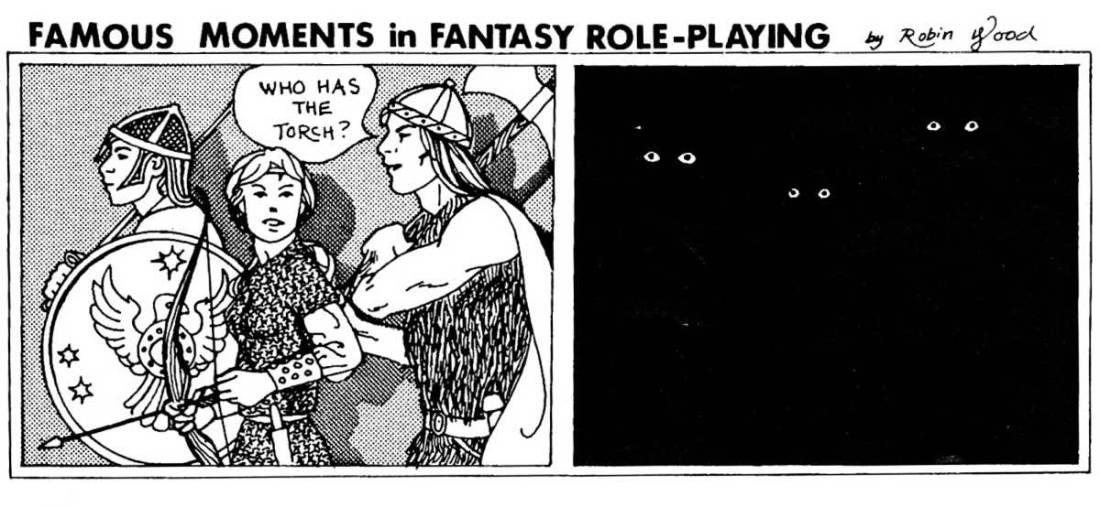
That player who reminds the DM to make things more difficult (Robin Wood, Different Worlds 35, Chaosium, July/August 1984)
[id: a two-panel black-and-white comic titled Famous Moments in Fantasy Role-Playing by Robin Wood
in the first panel a trio of adventurers walk down a hallway. one has a sword and shield, one has a bow, one has a large axe. the one with the axe asks “Who has the torch?”
the second panel is three sets of eyes in blackness]
Sometimes i think about the idea of Common as a language in fantasy settings.
On the one hand, it’s a nice convenient narrative device that doesn’t necessarily need to be explored, but if you do take a moment to think about where it came from or what it might look like, you find that there’s really only 2 possible origins.
In settings where humans speak common and only Common, while every other race has its own language and also speaks Common, the implication is rather clear: at some point in the setting’s history, humans did the imperialism thing, and while their empire has crumbled, the only reason everyone speaks Human is that way back when, they had to, and since everyone speaks it, the humans rebranded their language as Common and painted themselves as the default race in a not-so-subtle parallel of real-world whiteness.
In settings where Human and Common are separate languages, though (and I haven’t seen nearly as many of these as I’d like), Common would have developed communally between at least three or four races who needed to communicate all together. With only two races trying to communicate, no one would need to learn more than one new language, but if, say, a marketplace became a trading hub for humans, dwarves, orcs, and elves, then either any given trader would need to learn three new languages to be sure that they could talk to every potential customer, OR a pidgin could spring up around that marketplace that eventually spreads as the traders travel the world.
Drop your concept of Common meaning “english, but in middle earth” for a moment and imagine a language where everyone uses human words for produce, farming, and carpentry; dwarven words for gemstones, masonry, and construction; elven words for textiles, magic, and music; and orcish words for smithing weaponry/armor, and livestock. Imagine that it’s all tied together with a mishmash of grammatical structures where some words conjugate and others don’t, some adjectives go before the noun and some go after, and plurals and tenses vary wildly based on what you’re talking about.
Now try to tell me that’s not infinitely more interesting.
i find it fascinating how you said to stop thinking of common as “english, but in middle earth” and then proceeded to… precisely describe english, but in middle earth
i think my fav thing about griffin as a dm is that instead of going “unfortunately the ooze is immune to slashing damage :/” he says “if you were making a pb&j sandwich and you dropped some jelly on the counter, would you take a knife and just start cutting at it you dumb son of a bitch”
d&d be like
the characters: under no circumstances do i want to discuss my past, my trauma, my mental state or any other personal issues
the players: Somebody Please Interrogate My Child

