
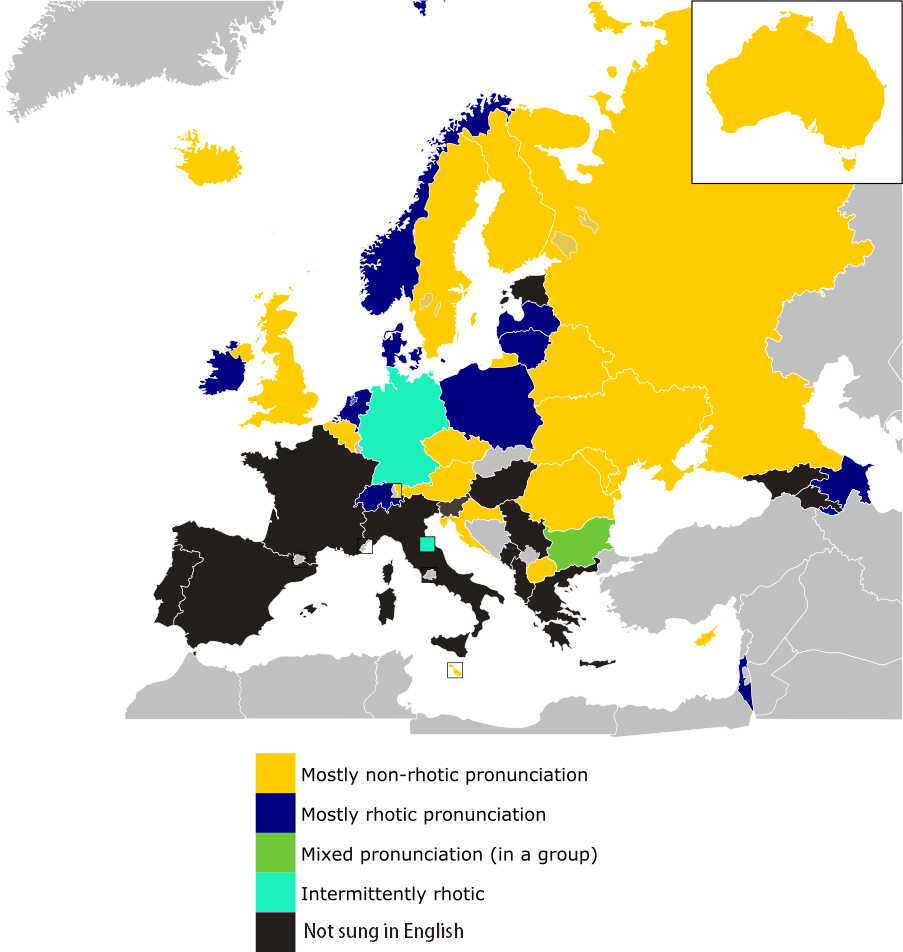
Good afternoon, folks, and welcome to today’s Eurovision map – it’s about something admittedly niche, but something that truly fascinates me as a linguist. This year, the number of entries not in English rose quite considerably to the highest proportion since 2013, but English remains the dominant language – but what variety?
Many non-native speakers tend to gravitate either towards American English, the most spoken variety, or British English, which has historically enjoyed a certain cachet in popular music, to the extent that many Americans often feigned English accents or at least adopted non-rhoticity when singing, the tendency to not pronounce historical <r> when it follows a vowel and is not immediately followed by another vowel, for instance in dark, car or barbecue.
Whilst there are a number of rhotic British accents (in Scotland, Northern Ireland, but even in some regions of England such as the West Country) and a number of non-rhotic accents in the US (most notably in New England and parts of the south), most learners emulate either the rhotic General American or the non-rhotic Received Pronunciation. Thus, by seeing if singers have mostly rhotic or non-rhotic pronunciations, we can see to a certain extent what variety of English dominates the contest.
Two years ago, my feeling that American English was dominating the contest was backed up with a staggering proportion of singers with rhotic accents, with Eastern Europe and the former USSR, somewhat ironically given the historical context, prone to adopting American English. This year, the pendulum has swung in the opposite direction, with 16 of the countries singing in English doing so with mostly non-rhotic pronunciations, including, this time, most of Eastern Europe. Interestingly, we even have, in Franka, an example of someone influenced by a non-rhotic American English accent (in this case, that of Boston.)
With 10 rhotic singers, rhotic pronunciations are still strongly represented, and they are interestingly mostly representing nations of Northern Europe, who, two years ago, were rather more likely to send non-rhotic singers. This group include Waylon, avowedly influenced by American genres; Laura Rizzotto, who lives in the states; and Netta, despite her time in predominantly non-rhotic Nigeria. We also have mixed pronunciation in the Equinox group, and two singers – Michael Schulte and Jessika – who swing so rapidly between rhotic and non-rhotic that I had to note them as “intermittently rhotic.”
What I find particularly interesting is the fact that few of the singers are purely rhotic or non-rhotic, with a tendency to not pronounce the r when it follows an unstressed schwa (as in forever) but to pronounce it relatively clearly after a and o. It may well be that [a] new type[/s] of partial rhoticity is/are emerging, independent of English’s major varieties!
 🍓🧀 (archive)