There’s no telling how many guns we have in America—and when one gets used in a crime, no way for the cops to connect it to its owner. The only place the police can turn for help is a Kafkaesque agency in West Virginia, where, thanks to the gun lobby, computers are illegal and detective work is absurdly antiquated. On purpose. Thing is, the geniuses who work there are quietly inventing ways to do the impossible.
Say there’s a murder. Blood everywhere, a dead guy on the floor. The cops come in with their yellow tape, chalk line, the little booties, cameras, swabs, the fingerprint dust. One of them finds a gun on the floor. The gun! He lifts it with his pinkie, examines it, takes note of the serial number. Back at the station, they run a trace on the gun. A name pops up. It’s the wife! Or: It’s the business partner! It’s somebody’s gun, and this is so exciting because now they know who did it.
Except—no. You are watching too much TV. It doesn’t work like that.
“Think,” says Charlie Houser, a federal agent with the ATF. We’re in his office, a corner, and he’s got a whiteboard behind him where he’s splashed diagrams, charts, numbers.
The cops run a trace on a gun? What does that even mean? A name pops up? From where? There’s some master list somewhere? Like, for all the guns all over the world, there’s a master list that started with the No. 1 (when? World War I? Civil War? Russian Revolution? when?), and in the year 2016 we are now up to No. 14 gazillion whatever, and every single one of those serial numbers has a gun owner’s name attached to it on some giant list somewhere (where?), which, thank God, a big computer is keeping track of?
“People don’t think,” Charlie tells me. He’s a trim guy, 51, full lips and a thin goatee, and he likes to wear three-piece suits. They fit loose, so the overall effect is awkward innocence, like an eighth grader headed to his first formal. “ I get e-mails even from police saying, ‘Can you type in the serial number and tell me who the gun is registered to?’ Every week. They think it’s like a VIN number on a car. Even police. Police from everywhere. ‘Hey, can you guys hurry up and type that number in?’”
…So here’s a news flash, from Charlie: “We ain’t got a registration system. Ain’t nobody registering no damn guns.”
There is no national database of guns. We have no centralized record of who owns all the firearms we so vigorously debate, no hard data regarding how many people own them, how many of them are bought or sold, or how many even exist.
…The National Tracing Center is not allowed to have centralized computer data.
“That’s the big no-no,” says Charlie.
That’s been a federal law, thanks to the NRA, since 1986: No searchable database of America’s gun owners. So people here have to use paper, sort through enormous stacks of forms and record books that gun stores are required to keep and to eventually turn over to the feds when requested. It’s kind of like a library in the old days—but without the card catalog. They can use pictures of paper, like microfilm (they recently got the go-ahead to convert the microfilm to PDFs), as long as the pictures of paper are not searchable. You have to flip through and read. No searching by gun owner. No searching by name.
“Okay?” Charlie’s tapping a box of Winston Reds. His smile is impish, like he’s daring you to say what needs to be said: This is a fucking nightmare…
If you google for his name and add -reductress you get only a handful hits with the same text in English or French, but from other pages. So reductress.com simply plagiarized it. Furthermore, the guy in the picture is standing in front of a whiteboard full of stuff that is not classics but neuroscience, you can see the word “hypothalamus” on there twice, and that’s not a Greek hero or something. They didn’t even bother retouching the image. Which is good, because this way TinEye can gladly tell us where they stole the pic: on a wikivisually page on
California police investigating a violent white nationalist event worked with white supremacists in an effort to identify counter protesters and sought the prosecution of activists with “anti-racist” beliefs, court documents show.
The records, which also showed officers expressing sympathy with white supremacists and trying to protect a neo-Nazi organizer’s identity, were included in a court briefing from three anti-fascist activists who were charged with feloniesafter protesting at a Sacramento rally. The defendants were urging a judge to dismiss their case and accused California police and prosecutors of a “cover-up and collusion with the fascists”.
Defense lawyers said the case at the state capital offers the latest example of US law enforcement appearing to align with neo-Nazi and white supremacist groups while targeting anti-fascist activists and Donald Trump protesters after violent clashes.
“It is shocking and really angering to see the level of collusion and the amount to which the police covered up for the Nazis,” said Yvette Felarca, a Berkeley teacher and anti-fascist organizer charged with assault and rioting after participating in the June 2016 Sacramento rally, where she said she was stabbed and bludgeoned in the head. “The people who were victimized by the Nazis were then victimized by the police and the district attorneys.”
Steve Grippi, chief deputy district attorney prosecuting the case in Sacramento, vehemently denied the claims of bias in an email to the Guardian, alleging that anti-fascist stabbing victims have been uncooperative and noting that his office has filed charges against one member of the Traditionalist Workers Party (TWP), the neo-Nazi group that organized the rally.
Some California Highway Patrol (CHP) investigation records, however, raise questions about the police’s investigative tactics and communication with the TWP.
Felarca’s attorneys obtained numerous examples of CHP officers working directly with the TWP, often treating the white nationalist group as victims and the anti-fascists as suspects.
The TWP is “intimately allied with neo-Nazi and other hardline racist organizations” and “advocates for racially pure nations”, according to the Southern Poverty Law Center. Its leaders have praised Trump, and the group claimed to bring more than 100 people to the Charlottesville white supremacist rally, where a counter-protester was killed.
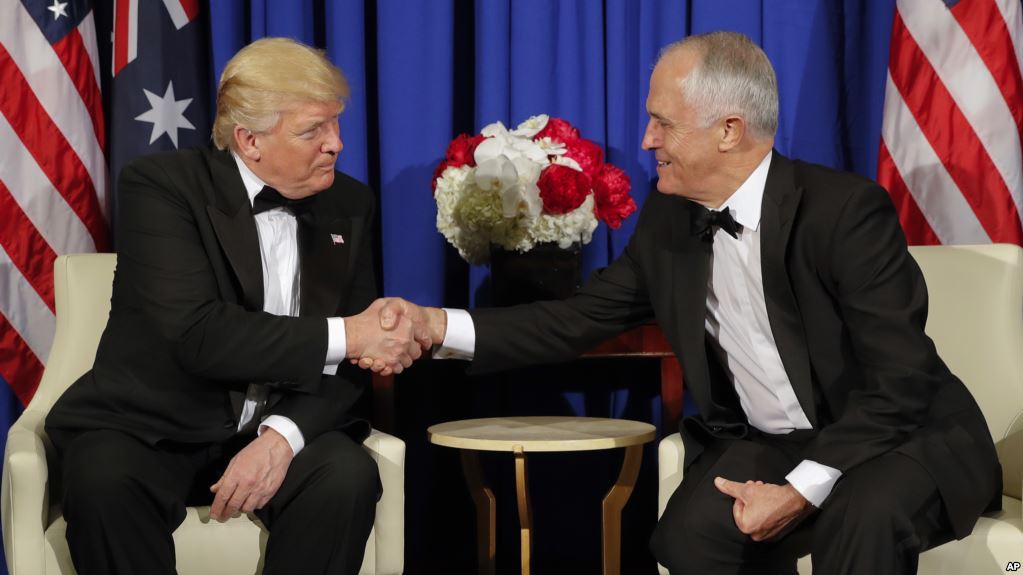
If Donald Trump is racist, so is Australia and Malcolm Turnbull, says US Homeland Security chief.
“We agree with you completely,” responded a large amount of Australians. “You’ve hit the nail completely on the head. They’re both a bunch of big old racists who have racist policies against refugees. Glad you’ve finally admitted it.”
“Actually I meant to use that as an argument as to why Trump isn’t racist,” replied the security chief, Kirstjen Nielsen.
“Nope. Doesn’t work that way. You’re bad at logic and also your president is a racist.”
Australians started singing a catchy sitcom-esque theme song. “Trump and Turnbull racists togeeetheerrr, you know what they say about birds of a feaaattherr. Treating refugees with disdain, I hope no one ever votes for them again! Badadadaaaa they’re bad people aaayeeahhaaa.” (followed by a guitar solo).
How rich do you need to be to be against sidewalks? The lack of sidewalks in lower-income areas is a recognized problem. You’re forced to spend extra money on gas/transit to run short-distance errands. Local shops can’t operate. Groceries are an ordeal; missing sidewalks and “food deserts” are correlates. You can’t take walks. The air quality ends up worse when more driving is required. If you’re living in reality, sidewalks are good and necessary.
Yep. It’s an overlapping class and racial issue. The most lethal roads for pedestrians are all in the South, and in the big cities here, it’s the African-American and Latinx neighborhoods where the most people die…
Smart Growth America noted 46,149 pedestrians were struck and killed by cars in the U.S. in the 10-year period, at a rate of about 13 people per day. The study found that minorities and older Americans are overrepresented among pedestrian deaths.
“Everyone involved in the street design process—from federal policymakers to local elected leaders to transportation engineers—must take action to end pedestrian deaths,” notes the study’s authors. “So long as streets are built to prioritize high speeds at the cost of pedestrian safety, this will remain a problem.”
Florida was the top state on the pedestrian danger index, and had eight of the top 10 metro areas. Jackson, Mississippi, and Memphis, Tennessee also came in the top 10. The report’s data is pulled from the U.S. Census Bureau and the National Highway Traffic Safety Administration’s Fatality Analysis Reporting System.
Lack of sidewalks in more affluent neighborhoods have the same origins. It discourages lower income people from entering the neighborhood because they don’t have cars and there are no sidewalks. This is why those neighborhoods are set up the way that they are. There are no bodegas on the corner. You can’t walk to the store. You must drive at least two miles to reach a store.
^^ and those kind of sidewalkless neighborhoods often go through unintended demographic change. For example, when Buford Highway in Atlanta became a heavily immigrant neighborhood, many people now live there in high-density apartment buildings, many are carless, there are bodegas and small businesses owned by immigrants up and down the highway. But because the immigrants lack the political power to improve the neighborhood like they desperately want to, it’s become ridiculously lethal. The latest statistic I found says that every year, 30 pedestrians are killed on Buford Highway and 250 are injured. Just look at these pictures of people trying to do normal activities back and forth across a seven lane highway. The trails where the grass is worn down have the depressing name of “desire paths,” according to this article.
The best reddit thread I’ve ever seen was when someone asked if the gang from Always Sunny in Philadelphia could kill Darth Maul and almost all of the responses were over 4 paragraphs long
Best quote from that thread: “To give the gang a slight advantage, We’ll assume that Darth Maul has not seen any of the films in the Home Alone franchise.”












 🍓🧀 (archive)