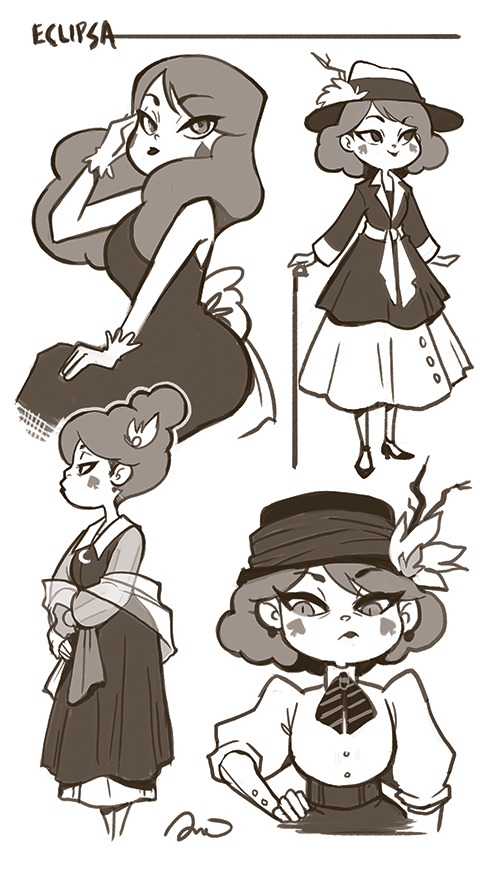
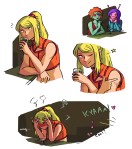
These were initial warm up sketches I wanted push a little further. I really like Eclipsa’s style and I was aiming for a similar period look in all her outfits.
idk if this has been posted yet but i read this thread by @teamarimo and found it SUPER interesting and thorough and thought it’d be good to share it
This is good, just wish it wasn’t posted as a Twitter essay, they’re so hard to read.
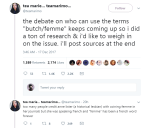
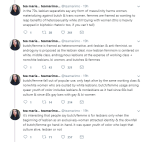
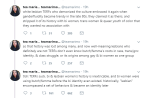
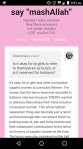
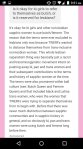
[Caption: a series of tweets by twitter user @teamarimo. It reads:
the debate on who can use the terms “butch/femme” keeps coming up so i
did a ton of research & i’d like to weigh in on the issue. i’ll post
sources at the end
too many people credit anne lister (a historical lesbian) with coining
femme in her journals but she was speaking french and “femme” has been a
french word forever
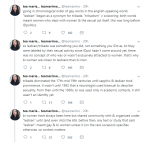
going in chronological order of gay words in the english-speaking world,
“lesbian” began as a synonym for tribade. “tribadism” = scissoring;
both words meant women who slept with women & the sexual act itself.
this was long before IDpolitics
so lesbian/tribade was something you did, not something you IDd as, bc
they were labeled by their sexual activity since IDpol hadn’t come
around yet. there was no concept of who was or wasn’t exclusively
attracted to women. that’s why bi women are closer to lesbians than bi
men
tribade dominated the 17th-mid 19th centuries until sapphic & lesbian took prominence. it wasn’t until 1892 that a neurologist used bisexual to describe sexuality. from then until the 1960s, bi was used only in academic contexts. it still wasn’t an identity yet
bi women have always been here but shared community with & organized
under “lesbian” until (and even into) the 60s. before then, any text or
study that said “lesbian” meant gay & bi women unless it (on the
rare occasion) specifies otherwise, so context matters
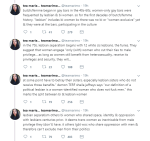
butch/femme began in gay bars in the 40s-60s. women-only gay bars were
frequented by lesbian & bi women. so for the first decades of
butch/femme history, “lesbian” includes bi women bc there was no bi or
“women-exclusive” yet & they were at the bars, participating in the
culture
in the 70s, lesbian separatism begins with 12 white cis lesbians, the
furies. They suggest that women engage “only (with) women who cut their
ties to male privilege… as long as women still benefit from
heterosexuality, receive its privileges and security, they will…
at some point have to betray their sisters, especially lesbian sisters
who do not receive those benefits.” demon TERF sheila jeffreys says “our
definition of a political lesbian is a woman-identified woman who does
not fuck men.” this marks the split between bi & lesbian women
lesbian separatism others bi women who shared space, identity &
oppression with lesbians centuries prior. it deems trans women as
inextricable from male privilege they (don’t) have. it others lgbt woc
who share oppression with men & therefore can’t exclude men from
their politics
tldr it’s bad lol. with events like stonewall (1969) & increasing
anti-gay violence in the 70s, anyone with proximity to heterosexuality
in gay spaces was viewed as a threat & shunned. so bi groups begin
to pop up, since they had no place in straight or gay communities
anymore
in the 80s, 2nd-wave bi organizing was feminist bi orgs forming bc
lesbians posited bisexuality as anti-feminist. by 1988, LGB officially
separates lesbian & bi. now lesbians are invested in specific
lesbian history & everything before the 60s says “lesbian.” see the
problem here
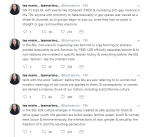
texts with the word “lesbian” before the 60s are also referring to bi
women but modern meanings of old words are applied to them, &
consequently, bi women are denied a massive chunk of our history,
including butch/femme culture
in the 60s, ball culture emerges in houses created as safe spaces for
black & latinx queer youth. the genders are butch queen, femme
queen, butch & women. here, butch & femme embody: the
intersections of race, gender & sexuality; the freedom of it; and
the resulting persecution
in the 70s, lesbian separatists say any form of masculinity harms women,
materializing against butch & trans women. femmes are framed as
wanting to reap benefits of heterosexuality while still toying with
women (this is heavily wrapped in biphobic rhetoric too, if you can’t
tell)
butch/femme is framed as heteronormative, anti-lesbian &
anti-feminist. so androgyny is proposed as the lesbian ideal. now
lesbian feminism is centered on white, middle class, androgynous
lesbians at the expense of working class + nonwhite lesbians, bi women,
and butches & femmes
butch/femme fall out of popular use, only kept alive by the same working
class & nonwhite women who are ousted by white lesbians.
butch/femme usage among queer youth of color includes lesbians &
nonlesbians as it had since 60s ball culture & since 40s gay bars
with gay & bi women
it’s interesting that people say butch/femme is for lesbians only when
the beginning of lesbian as an exclusively-woman attracted identity
& the downfall of butch/femme go hand-in-hand. it was queer youth of
color who kept that culture alive, lesbian or not
white lesbian TERFs who demonized the culture embraced it again when
genderfluidity became trendy in the late 80s. they claimed it as theirs,
and stripped it of its history with bi women, trans women & queer
youth of color that they wanted no association with
so that history was lost among many, and now well-meaning lesbians who
definitely are not TERFs don’t even know butch/femme’s roots in race,
trans/gnc identity, & class struggle, or its origins among gay &
bi women as one group
tldr: TERFs suck, bi & lesbian women’s history is inextricable, and
bi women were using butch/femme before the bi identity even existed.
historically, “lesbian” encompassed a set of behaviors & became an
identity later
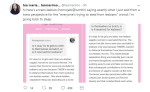
hi here’s a trans lesbian (homojabi@tumblr) saying exactly what I just
said from a trans perspective for the “everyone’s trying to steal from
lesbians” crowd. I’m going back to sleep
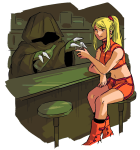
when you’re a super hot super famous intergalactic bounty hunter with an image to maintain but also you were raised in isolation by birds and so you don’t know how to talk to girls
Samus is listed under Disaster because while in most situations she’s a stone cold badass who can stare down a dragon, being raised by birds means she’s absolutely horrendous at flirting and ends up resorting to squawking and giving girls cool rocks she finds
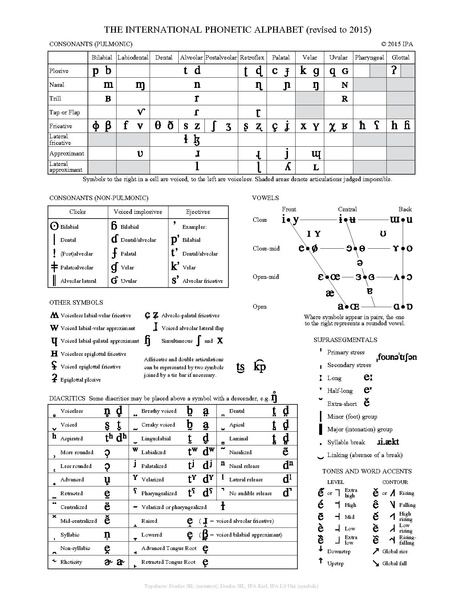
I present to you the
International Phonetic Alphabet (IPA). ( IPA website)
Basically this here is the cheat code for all pronunciation of every language
E v e r y. L a n g u a g e.
How?? Well, each symbol corresponds to one sound.
The table shows you where the sound is located and what your tongue has to do to pronounce that sound.
Example:
æ is said at the back of your throat while your throat is around halfway closed (indicated by its location relative to the words “open” and “front). This sound is found in
“back“ (in the Standard/General American dialect).
ŋ
is said by touching the base of your tongue to where the roof of your mouth gets soft (the velum) and exhaling through your noise while making noise (indicated by “velar” and “nasal”). This sound is found “song”.
As you can see, “ng” in “song” is made up of two letters that have different sounds while separate, but together they make a different sound. And English has some letters that correspond to several sounds all on their own! This is the case on many other languages, and trips up a lot of foreign language learners.
IPA ELIMINATES THIS DIFFICULTY BECAUSE EACH SYMBOL = 1 SOUND
lol sorry for all caps but im excited and this is important so
But how will this actually help you? Because dictionaries are amazing.
See that? That’s the entry for “language” in my Korean-English dictionary
(edited bc the previous picture had a pseudo-IPA and my sleep-deprived brain didn’t realize it until @korean-with-jangmi and
@gaybluecolson
pointed it out).
language -> ‘læŋgwɪdʒ
Pretty cool, right?
Here are some examples of IPA in action in different languages:
French: deux -> /dø/
Korean: 내가 -> /nɛ-ɡa/ or /ne-ga/
Afrikaans: seun -> /sɪøn/
Standard Arabic: عَيْن -> /ʕajn/
Ready to try this out for your own?
If you just want to only know how to pronounce your target language’s sounds:
Learn how to say the sounds in your TL by understanding the column/row titles that they are in on the IPA chart
(consonants here and vowels here)
Optional (or if you don’t have a dictionary):
Get the IPA charts for your target language (usually on its wikipedia page at “_target language_ Phonology”. If it’s not there then look up “_target
language_ IPA transcription”)
Example of IPA consonant and vowel charts (Afrikaans):
It’s a lot less intimidating when it’s the sounds for only one language, right?
REMEMBER: you don’t need to be able to pronounce every sound in IPA to make use of this chart, just know how to make them and what these symbols sound like (more or less) and your life of learning pronunciation will be so much easier
So there you have it:
The Secret to Perfect Pronunication in Any Language
Go, be free my language-learning friends, go pronounce things like natives!
and get rid of that nasty romanization for all my fellow korean learners
(oh
and if anyone has any questions about this, send em my way! i know
there are a couple linguistics blogs that follow me so if any of yall
wanna add smth, plz do!)
yall better reblog the heck outta this bc my hard work CANNOT go wasted ok?? i’ve been researching/writing/revising this for idk how long and my head hurts really bad asjdfsdg help




 🍓🧀 (archive)