
what she says: i’m fine
what she means: in Star Trek II: The Wrath of Khan, spock performs a mindmeld with dr. mccoy, depositing his katra, or soul, into the latter’s mind. the katra transfers at the moment of the mind-meld rather than at the point of the original holder’s death. spock gives mccoy his katra before he enters the radiation chamber. when kirk arrives to the scene, spock asks him ‘ship… out of danger?’ to which kirk assures him that all are safe. then spock tells him ‘i have been and always shall be your friend’ and dies. in Star Trek III: The Search for Spock, once spock’s katra is reintegrated with his body, he approaches kirk and asks him ‘ship… out of danger?’ again, clearly not remembering any of the events after he placed his katra in mccoy’s mind. however, soon after, he tells kirk ‘i have been and ever shall be your friend,’ a clear echo of his previous ‘i have been and always shall be your friend,’ which he should not be able to remember. there is no in-universe explanation for this, UNLESS kirk was thinking of spock’s death and how he said ‘i have been and always shall be your friend’ and those thoughts transferred through a vulcan marital bond to spock’s mind, in which case spock’s vocalisation of those thoughts, which was said in a questioning manner, could have been a test to see if their marriage bond were still in place.
Tag: st
lol if you think you like star trek and you hate diversity then pal I got good news for you: star trek hates you
types of tng episodes
- data’s journey of self-discovery
- worf’s social problems
- discovering a previously unknown relative, who probably dies at the end
- The Holodeck Is Being Weird
- something infects everybody and makes them act weird
- border disputes
Geordi making friends with someone, thus benefiting interspecies relations
Picard has to deal with his feelings
Riker finding a new alien to kiss, and subsequently lose
- Troi’s mom comes to visit; is herself as usual
- The Romulans are at it again
- New insight/understanding of The Borg
- “We’ve outgrown our materialistic ways”
- Q EPISODE!!! *party music*
• WORF PISSES OFF THE KLINGONS
• Worf makes nice with the Klingons
• WORF PISSES THEM OFF AGAIN
au where it is the 50 foot spock from the animated series that creates the kelvin timeline and no one says anything about the fact he’s 50 feet tall or animated in the same style
Okay, some fandom history, why show writers and authors say “for legal reasons” the can’t read fan fic.
Back in ancient times in the 1970s there was a show called Star Trek the Animated Series. It was on the air as fandom culture around Star Trek was really taking route and there were many fanzines (things on actual paper that people bought) being published and the first conventions to attend.
David Gerrold was a writer for Star Trek the Animated Series who had also written one of the most famous episodes of the original series The Trouble with Tribbles. While he was around the production office for STtAS he was introduced to a couple of fans who proceeded to tell him all about their ideas for an episode–essentially a sequel to his famous episode–which it so happens he had already written a script for. When that episode aired he received a letter from one of those fans lawyers demanding “credit”. It so happened that he could prove that the episode existed before the meeting but the involvement of lawyers and a threat to sue became widely known.
Marion Zimmer Bradly was, before recent horrifying revelations decades after her death, a titan of fantasy writing. She also welcome fan fiction and published it in anthologies and in a magazine she published. One day she opened a story sent to her and the plot of the story was essentially the plot of a a novel she had nearly finished writing. More than a years worth of her work was now unpublishable because it was provable that she had read this story with this similar plot and she couldn’t prove the work on the novel existed before she saw the story. She stopped publishing anthologies and fan fiction and in particular the MZB story is the one a lot of professional writers know as representative of the dangers of fan fiction.
So when a writer says they can’t read fan fiction for legal reasons it’s that their own lawyers are protecting them from outside lawsuits.
And this is why knowing your fandom history matters.
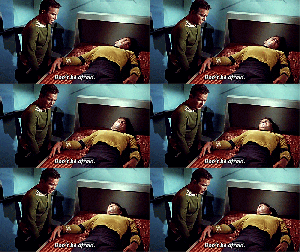
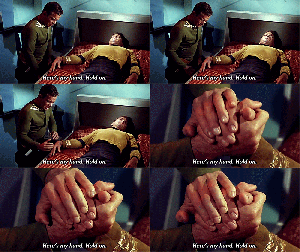
Kirk comforting the evil version of himself is so weird and so sweet, and honestly let’s all try to be that gentle with ourselves.
spock: the needs of the many outweigh the needs of the few
kirk: ✔️read stardate 8130.3
I HAVE NEVER HEARD SUCH ROMANTIC DIALOGUE IN ANY BOOK, MOVIE, OR TV SHOW AS I HAVE IN “SEARCH FOR SPOCK”
-“the noblest part of myself”
-“some of our dearest blood”
-“We were separated…he couldn’t touch me.”
-“eternal soul…as if it were my very own”
-“the cost would have been my soul”
god and have you heard the SOUNDTRACK
Oh please explain the soundtrack, I would pay you if I could 😍
ALRIGHT HERE WE GO. THIS IS GONNA BE LONG.
in Wrath of Khan, there is a one-minute track called “Spock” that plays when kirk comes into spock’s meditation zone, around where the line “i have been and always shall be yours” is said. That melody is spock’s melody; it essentially follows him throughout the movie and it plays when he dies.
In Search for Spock, as kirk goes on Sadness Walks™ around the enterprise, saying he’s left the noblest part of himself down there on that newborn planet, spock’s melody plays – spock is haunting him, even in the soundtrack. spock’s melody also plays in spock’s cabin.
When sarek mindmelds with kirk, spock’s melody is very very strong, showing how present spock is in kirk’s thoughts. The melody is more present in kirk’s mind than it was in spock’s cabin (or any other place) aboard the enterprise.
What’s interesting is that musical tracks between lovers often are heavy on the strings (violins in particular). The music that plays between kirk and spock when they are reunited on Vulcan uses strings and a Vulcan horn. The spock melody comes back just as spock comes back (that’s the bit on the Vulcan horn) and the backing note is violin.
This is all well and good, but NONE OF THESE LITTLE FACTS ARE MY FAVORITE BIT. (okay, maybe the part about the spock melody being in kirk’s thoughts make me a little emo. but anyway.)
What i want to talk about next is a bit subtle and required some digging; it’s about the ten-minute jazz piece that plays in the bar scene early in the movie. it lacks lyrics and may not seem significant, but when you look at the lyrics to the songs it is composed of (”That Old Black Magic” “Tangerine,” and “I Remember You”), they foreshadow the events of the movie. Let’s look at “I Remember You” first:
“I remember you; you’re the one who said you love me true”
and
“When my life is through and the angels ask me to recall the thrill of them all, I shall tell them I remember you.”The song is about remembering a loved one; that is – surprise – the entire end scene of the movie. Spock remembers, saying “Jim… your name is Jim,” and “I have been and ever shall be your friend.” (which incidentally reminds me of an old Indian wedding vow which includes the lines “we may ever live as friends.” But that’s beside the point… or is it?)
“Tangerine” is a pretty standard bar love song. So is “That Old Black Magic,” but there is a couplet in there that really jumped out at me.
“You are the lover that I’ve waited for, the mate that fate had me created for.”
And that’s pretty damn perfect for their relationship, isn’t it?
If you want to know what James Horner (the composer for both Wrath of Khan and Search For Spock) has to say about all this:
“What was most important to me as a storyteller was the relationship between Captain Kirk and Mr. Spock. (…) I set up this relationship, this bond between these two characters and that was the key to Star Trek II. (…) What has to be brought to the surface more in the storytelling is the deep affection that occurs between these two characters, Spock and Kirk, and that’s really what I focussed on. It ended up fortuitously working to set it up that way because it cemented something that wasn’t in the first movie; it cemented something on a big scale that wasn’t in the television series. It was always implied. I tried to nail it in the movie (…) It was all about that relationship.” (x)
So, you know. Make of all that what you will, but it all seems damn romantic to me.
 🍓🧀 (archive)