kylo ren: soon as she unblocks me the wedding is back on
Tag: text
I love being a woman. A capital G Girl. A fine young lady. It’s great that I identify as a woman and am One! Isn’t it just a wonderful day when you wake up and realise “Hey! Am girl!” What an age we live in.
On today’s edition of “wtf are you talking about:” someone just “respectfully disagreed” with me that water is a necessity of sustaining human life.
Shirts are crazy, your body goes in 1 hole and out 3
excuse me
T3rf: trans women have Male Socialization
The medical community: you keep using that word, I do not think it means what you think it means.
The only reason terfs try to insist on things like male socialization and biology is they want to appear to people that their hate and disgust is justified, and hopefully they use these talking points to drag people along by inciting on their emotions and the like.
Funny thing tho: you apply actual feminism to each point and it falls flat.
Male socialization? Baloney, because there’s lots of examples of kids growing up under single moms with varying degrees of gender representation.
Biology? DNA may be a blueprint for morphology to some degree, but nature is far too weird to apply just two things to describe everything.
TERFs also tend to believe “male socialisation” is fixed at birth, effectively that babies assigned male are born abusive. under this model the patriarchy isn’t even a set of ideas or a choice to uphold a broken system, it becomes an inbuilt feature of the human race that can’t ever be defeated. which is terrifying.
It flies in the face of every other psychological theory of socialisation, has never been peer reviewed or considered as actual science. and the obvious: babies don’t seem to even have thoughts until a few weeks after birth, and the system of gender that babies are immersed in takes a lot of time to learn.
it’s really nothing but recycling the brain sex argument. I’ve never heard of a radfem who can admit that socialisation could ever be malleable, or even fixed at a certain age after birth because that might mean admitting the existence of trans people who realise they’re trans in early childhood. I haven’t even seen radfems consider the thought that people could receive a different socialisation in different cultures with different ideas if gender. they’re effectively claiming the gender framework in the western world is a timeless universal constant, and at this point it’s interchangeable with their “the Patriarchy is found on the Y chromosome” theory.
*2nd dr who voice* oh my Word!! oh crumbs!!! oh Fuck
self care is just going the hell to bed
drink your FUCKING water
taking your god damn medication
m/f ships that involve trans people or poc are more revolutionary and important than you fucking assholes give them credit for
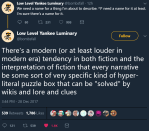
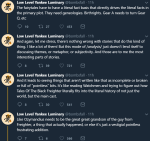
more in this great twitter thread by the co-creator of Night in the Woods
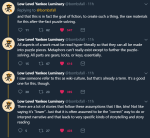
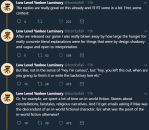
[Image description: A series of tweets by Low Level Yankee Luminary, @bombsfall. They are transcribed below as text broken into paragraphs by tweet.]
We need a name for a thing I’m about to describe. *I* need a name for it at least. I’m sure there’s a name for it.
There’s a modern (or at least louder in modern era) tendency in both fiction and the interpretation of fiction that every narrative be some sort of very specific kind of hyper-literal puzzle box that can be “solved” by wiki and lore and clues
and that this is in fact the goal of fiction, to create such a thing, the raw materials for this after-the-fact puzzle solving.
All aspects of a work must be read hyper-literally so that they can all be made into puzzle pieces. Metaphors can’t really exist except to further the puzzle-solving. All parts are gears, locks, or keys, essentially.
I saw someone refer to this as wiki-culture, but that’s already a term. It’s a good one for this, though.
There are a lot of stories that follow these assumptions that I like, btw! Not saying that it’s “lower”. Just that it is often assumed to be the “correct” way to do or interpret narrative and that leads to very specific kinds of storytelling and story reading
The replies on this are really great on this already and I’ll RT some in a bit. First, some context:
After we released our game I was really blown away by how large the hunger was for really concrete literal explanations for things that were by design shadowy and vague and open to interpretation.
But like, not in the sense of “hey I’m curious”, but “hey you left this out, when are you going to finish it or write the backstory lore etc”
Or, for example, we spent a lot of time on in-world fiction. Stories about constellations, fairytales, religious narratives. And I’d get emails asking if Mae was the descendant of an in-world fictional character. B/c what was the point of the in-world fiction otherwise?
The fairytales have to have a literal fact basis that directly drives the literal facts in the primary plot. They need genealogies. Birthrights. Gear A needs to turn Gear Q, etc.
And again, let me stress, there’s nothing wrong with stories that do this kind of thing. I like a lot of them! But this mode of /analysis/ just doesn’t lend itself to discussing themes, or metaphor, or subjectivity. And those are to me the most interesting parts of stories.
And it leads to seeing things that aren’t written like that as incomplete or broken or full of “pointless” bits. It’s like reading Watchmen and trying to figure out how Tales of the Black Freighter literally fits into the literal history of not just the world, but the main cast.
Like Ozymandius needs to be the great great grandson of the guy from Freighter, a thing that actually happened, or else it’s just a vestigial pointless frustrating addition.
 🍓🧀 (archive)