
Alternatives to villainous redemption arcs:
- Revealed that villain’s schemes secretly served the greater good, somehow
- Villain switches teams out of expedience; protagonists overlook the fact that they’re still a huge jerk because they now benefit from it
- Context or status quo altered so that villain’s previously harmful actions become constructive and useful with no changes on their part
- It turns out that villain wasn’t actually responsible for the one specific thing the protagonists are trying to stop or get revenge for; everything else they clearly did do conveniently ignored
- Villain never repents or makes amends for any of the awful stuff they did, but they’re really hot, so no one cares
Tag: writing
Q&A: When it comes to women, “Realism” is often wrong
I’m writing a story set in the Victorian era, something I have done a lot of research on, and my female character (a teenager) is a skilled fencer. I have been told that this is ‘unrealistic’ despite research telling me noble women would have actually been ENCOURAGED to fence, as fencing was seen as graceful. I was going to have her get into a duel but I’m worried readers aren’t going to believe woman could fence back then and impose even more restrictions than were in place at the time.
So, with fiction, you can essentially normalize whatever you want. You’re not limited a very narrow view of someone else’s reality. You create the reality your readers experience. You shape the world to your liking. You have that control, you have that power, and, when you get good at crafting new realities, your readership won’t question it because you never gave them the opportunity. However, the trick with normalization is understanding there needs to be more than one. You need many characters from in a multitude of age groups in order to normalize a behavior pattern in a setting.
Never forget, you are the creator and they are the consumer. The consumer doesn’t dictate what the creator creates. A well-written story will always find a home, even one filled with uncomfortable and inconvenient truths. Be confident that you’ll find yours.
Remember, perception of history doesn’t outweigh real history except when we ignore the real history’s existence. The fact women were encouraged to fence as they were encouraged to participate in other sports like tennis for the benefit of their health doesn’t outweigh the sexism which existed in Victorian England. It also doesn’t reject women’s participation in sports as being seen as secondary to men’s. Their participation treated as less “legitimate”, less serious, and entirely hobbyist. Which is not so different from how women’s professional sports are treated today.
The trouble with the presentation of many female characters who fight (and this has been normalized) is that they’re the only one. They’re the trailblazer, the only one who fights, who earns her stripes by playing with the big male dogs, who is different from other women. This gives them the position of being special and unique. However, by being different from other woman in such a big way, we cut the setting off from normalizing female participation and the concept of a woman fighting is treated as abnormal. A single outlier is not normalization, and isn’t really proving anything. In fact, the treatment of a female fighter as being different, unique, and special due to her gender throws the violence and combat ball squarely into the male court. By normalizing violence as the domain of men, these female characters are framed as infringing on spaces inherently male rather than just culturally male. This treatment of sex and gender ends up normalizing the very sexist stereotypes and cultural mores that the narrative is trying to combat. The treatment posits that men are inherently and naturally better at combat than women because violence is male, and the truth that combat is a skill you practice and work at in order to be good gets lost.
Women have always fought. You’ll find at least two women in just about every martial arts class, and probably more. There will be older women and younger women, the women who threw off society’s rules to completely embrace their martial calling, the women who didn’t, the women who are there just for that bit of added grace, the ones who are there because their mother or father made them, the ones who love it, the ones who aren’t really interested in fencing. They’re just crushing on the salle’s fencing instructor or taking the opportunity to go husband hunting among the available gentry. You need lots of female characters with varying opinions on the subject and with their own reasons for engaging in the sport. The primary opponents for a female fencer are going to be other female fencers, and that’s also who she’ll be training with; even if the master is a man. Where women dueling women is acceptable, women dueling men will be socially frowned upon. This doesn’t mean a woman can’t duel a man on equal terms, they can. However, the social and societal consequences for breaking with tradition are much more severe.
This is where the sexism the audience has been trained to expect leaks back in. The mental jump is in the statement: “it is socially frowned upon for women to do X” and the logic then becomes “women can’t do X!” because we don’t talk about the ones who challenged social mores. There’s the assumption, and then there’s the reality. Audiences demanding realism often overfocus on their assumptions, rather than what is real. Fiction is a poor substitute for the real world, which is often much more complicated. The reality is women’s fencing as a codified sport has been thriving for over a century. Women have been fencing and fighting for much longer than that. Women learned and practiced self-defense in Victorian England, there were women who did fight in live duels against other women, and there were those who participated in the sport purely as a means of exercise.
Women didn’t duel in Victorian England, they say? We have actual historical events of women dueling topless, and not for the entertainment of male or female spectators. No, they dueled topless to avoid infection and to keep cloth from going into the wound. In this particular instance, the countess and the princess were dueling over floral arrangements for an upcoming musical exhibition.
The reasons your characters have for dueling could be really, really out there. Violence over floral arrangements may not make sense to us, but it did to them. Humans can be really out there, and history isn’t a sham collection of men doing everything while women stayed home. History is littered with badass women from all over the world doing crazy things. I wouldn’t even say that a woman dueling a man in Victorian England would actually be all that out there because women did, what would be unrealistic is there being no consequences (societal or otherwise) for the act. There were certainly women who openly flouted convention. Novelist George Eliot is one example. Female prize fighter and all around bare knuckle boxing champion, Elizabeth Wilkinson Stokes is another.
However, culture involves more than one.
If you want to portray an attitude as normal, you need to have your characters treat the attitude like it’s normal and back that up with a robust mixed gender cast. Women are drawn to violence in the same way men are, and female members of the aristocracy certainly did duel each other. There were articles written on the subject of how fencing is good for women’s health.
So, should you fear detractors? No, you shouldn’t.
Don’t give them power over your work. Women have been carving out their place in the world of professional sports and on the battlefield for a long, long time. The tragedy is that our culture at large pretends they don’t exist in order to uphold the sexist mores underpinning our society. Remember, women make up half of the human race and half of every society. Honestly, read this article. The Boy’s Club may be societally acceptable, but it’s actually unrealistic.
So, if you want normal, jam your work full of female fencers of every age. Main characters, secondary characters, side characters, and cameos. Female friends, female rivals, female mentors, female teachers, female assistants, female family members, female characters who just don’t understand, female characters of every stripe imaginable. Women who fence, women who don’t, women who look down their nose at it, women who think its unseemly, women who long to be taken more seriously, and the women who just don’t care what society thinks. Those do it anyway. All these types of women have existed.
You’ll always find detractors, but the answer is easy.
Do it anyway.
-Michi
Q&A: When it comes to women, “Realism” is often wrong was originally published on How to Fight Write.
“op doesnt fucking matter”
— roland barthes, la mort de l’auteur (1967)
Seriously, though, seeing Liam O’Brien and Mark Hamill and the McElroys all maintaining that “you, our audience, are an essential part of our art, your interpretations matter, if you see yourself in this character and want to make them yours’ in some way, that is totally valid” has just been so healing to me.
It’s been such a nice change of pace from other male creators who will “well, actually” you if they think they’ve given you the slightest hint that their character might be queer or neurodivergent, or who fuss and wring their hands about ways to “””naturally””” make a character those things.
And it just gives us more evidence that those other creators can and should do better by us.
Bad writer who doesn’t understand the value of brevity: “For sale, baby shoes, never worn.”
Me, a good writer: “Baby’s dead.”
more in this great twitter thread by the co-creator of Night in the Woods
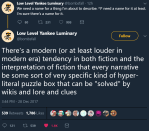
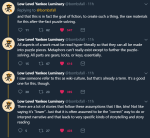
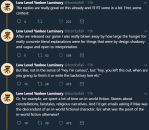
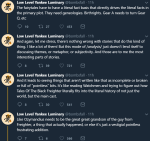
[Image description: A series of tweets by Low Level Yankee Luminary, @bombsfall. They are transcribed below as text broken into paragraphs by tweet.]
We need a name for a thing I’m about to describe. *I* need a name for it at least. I’m sure there’s a name for it.
There’s a modern (or at least louder in modern era) tendency in both fiction and the interpretation of fiction that every narrative be some sort of very specific kind of hyper-literal puzzle box that can be “solved” by wiki and lore and clues
and that this is in fact the goal of fiction, to create such a thing, the raw materials for this after-the-fact puzzle solving.
All aspects of a work must be read hyper-literally so that they can all be made into puzzle pieces. Metaphors can’t really exist except to further the puzzle-solving. All parts are gears, locks, or keys, essentially.
I saw someone refer to this as wiki-culture, but that’s already a term. It’s a good one for this, though.
There are a lot of stories that follow these assumptions that I like, btw! Not saying that it’s “lower”. Just that it is often assumed to be the “correct” way to do or interpret narrative and that leads to very specific kinds of storytelling and story reading
The replies on this are really great on this already and I’ll RT some in a bit. First, some context:
After we released our game I was really blown away by how large the hunger was for really concrete literal explanations for things that were by design shadowy and vague and open to interpretation.
But like, not in the sense of “hey I’m curious”, but “hey you left this out, when are you going to finish it or write the backstory lore etc”
Or, for example, we spent a lot of time on in-world fiction. Stories about constellations, fairytales, religious narratives. And I’d get emails asking if Mae was the descendant of an in-world fictional character. B/c what was the point of the in-world fiction otherwise?
The fairytales have to have a literal fact basis that directly drives the literal facts in the primary plot. They need genealogies. Birthrights. Gear A needs to turn Gear Q, etc.
And again, let me stress, there’s nothing wrong with stories that do this kind of thing. I like a lot of them! But this mode of /analysis/ just doesn’t lend itself to discussing themes, or metaphor, or subjectivity. And those are to me the most interesting parts of stories.
And it leads to seeing things that aren’t written like that as incomplete or broken or full of “pointless” bits. It’s like reading Watchmen and trying to figure out how Tales of the Black Freighter literally fits into the literal history of not just the world, but the main cast.
Like Ozymandius needs to be the great great grandson of the guy from Freighter, a thing that actually happened, or else it’s just a vestigial pointless frustrating addition.
“a writer’s character’s viewpoints don’t reflect the writer’s viewpoints!!!” actually, they do.
that doesnt mean having a, for instance, homophobic character means the author is homophobic. but how is the homophobia treated? is it criticized? is it excused, idealized? is it framed so that the homophobia is clearly wrong? does the inclusion of homophobia in the narrative serve a point?
writers, especially professional published writers, know that their writing has an impact, and the morals they put forward in their work reflect deeply on themselves. they know how they frame and present their work can completely change the result and effect it has.
so maybe the character’s viewpoints don’t say much about the writer, but how the writer presents this character and its viewpoints says a hell of a fuckin lot about the writer.
projecting all ur issues™ onto fictional characters is a time honored tradition. if kafka can give a cockroach his depression and deepseated fears of uselessness i can give a comic book character my personality disorder and sexual traumas. god’s dead and soon we will be too so in 2018 write all the weirdly specific Coping Fic you want and don’t let people get on your case about it
not to sound like tumblr but i really do wanna see more flawed woman characters who are fucked up in ways that impact themselves and others, but not centered around the harm they do onto men/male love interests. like “flawed” women in media always are seen as broken due to their inability to fit within a heteropatriarchal household. they cant cook/clean, they dont show love, they dislike children, they are cold/distant. and like thats fun i guess until they get fixed for a man which is boring. and its not that i want them to never develop as people, but i wanna see this development happen in a way that isnt focused on which guy theyre fucking, ya know. and i wanna see more interesting fucked up girls that are messed up in ways that are funny or heartbreaking and obnoxious or tragic. sometimes it gets fixed and sometimes it doesnt and sometimes theyre bad people and sometimes theyre just realistic! ya know!
but like that said im also really tired of women with flaws being abusive, racist, hurtful, and degrading. im not gonna write up headcanons about how the space nazi in star wars probably cooks dinner for the army she helps enslave! i dont care about the gritty realism of jessica jones manipulating and abusing a system of racism to leverage herself above the black men in her life! im uncomfortable with women who are abusive and uncaring towards their romantic partners! and yes i can appreciate some of these women being written as villains or antagonists and fleshed out in a way to carry on the story, but these arent the stories that reflect the types of people i want to look up to. and im really uncomfortable with the type of discourse that goes around insisting that i have to see these girls as ~feminist~ icons even though they reflect the same white abusive women who time and time again dehumanize and wreck me.
i dont know man! girls! they exist! i want complicated women who im able to relate to their flaws and struggles!
those posts that are like “enough [popular and narratively satisfying literary trope]! give me [extremely boring subversion]!”
 🍓🧀 (archive)