
shoutout to my Dumb ravenclaw lesbians! my girls who dont know shit!!!!!! you are valid!!!!!! i see you!!!!!
Author: peasantchick
Concept: What if there was a community that observed a prolonged period of silence, during which vocalization was forbidden, on a regular basis (say, one day a week) due to religious/cultural reasons? Such a community would undoubtedly develop a sign language if the tradition was maintained long enough. Deaf members of the community might be admired or accorded an honored status within the context of the day of silence because they would likely be viewed as having no temptation to break the silence. If religious services or ceremonies were conducted on the day of silence, a writing system for the sign language might be developed in order record the prayers and or other signed texts used throughout the day.
Regarding the relationship between the spoken and signed language, the sign language might simply be a signed mode of the spoken language, like Signed Exact English. It might be a different register or dialect of the spoken language, with a greater or lesser amount of grammatical and lexical differences. Or, it might be a completely unrelated language, as American Sign Language is to English. All of these possibilities are attested in various communities which have or historically had sign languages which were used in addition to or instead of the community’s spoken language in various contexts.
This has happened! In a lot of Australian Aboriginal languages and clans, sign languages have evolved as registers to replace dialogue in traditional avoidance relationships, for example a man is supposed to never speak directly to his mother in law, so he either communicates with her via a third person or they use sign languages. Usually the most proficient in these registers and languages are elderly women who’ve had to undergo a long mourning period, during which they aren’t allowed to speak to anyone but can communicate in sign. These women often become fluent and are able to communicate just as efficiently and clearly in sign amongst themselves as they would be able to work a spoken language.
Today is International Trans Day of Visibility. If you see a trans person climbing in through your window and stealing pasta from your kitchen, ignore them. This is not new. This is a regular occurrence, but this is the only day of the year when you can actually see them do it.
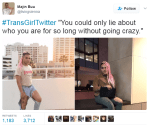
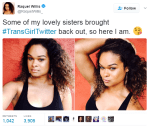
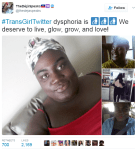
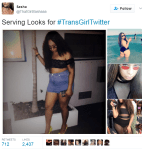
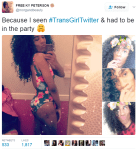
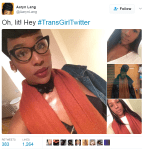
These trans girls of color are so beautiful and brave!
I am really proud of them all.

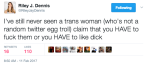
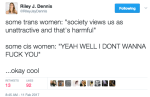
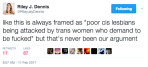
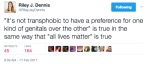
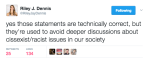
Riley J. Dennis is honestly a gem
[Caption:
A collection of tweets from Riley J. Dennis (@RileyJDennis) on Twitter
I’ve still never seen a trans woman (who’s not a random twitter egg troll) claim that you HAVE to fuck them or you HAVE to like dick
some trans women: “society views us as unattractive and that’s harmful”
come cis women: “YEAH WELL I DON’T WANNA FUCK YOU”
…okay coollike this is always framed as “poor cis lesbians being attacked by trans women who demand to be fucked” but that’s never been our argument
“it’s not transphobic to have a preference for one type of genitals over the other” is true in the same way “all lives matter” is true
yes those statements are technically correct but they’re used to avoid deeper discussions about cissexist/racist issues in our society
End caption.]
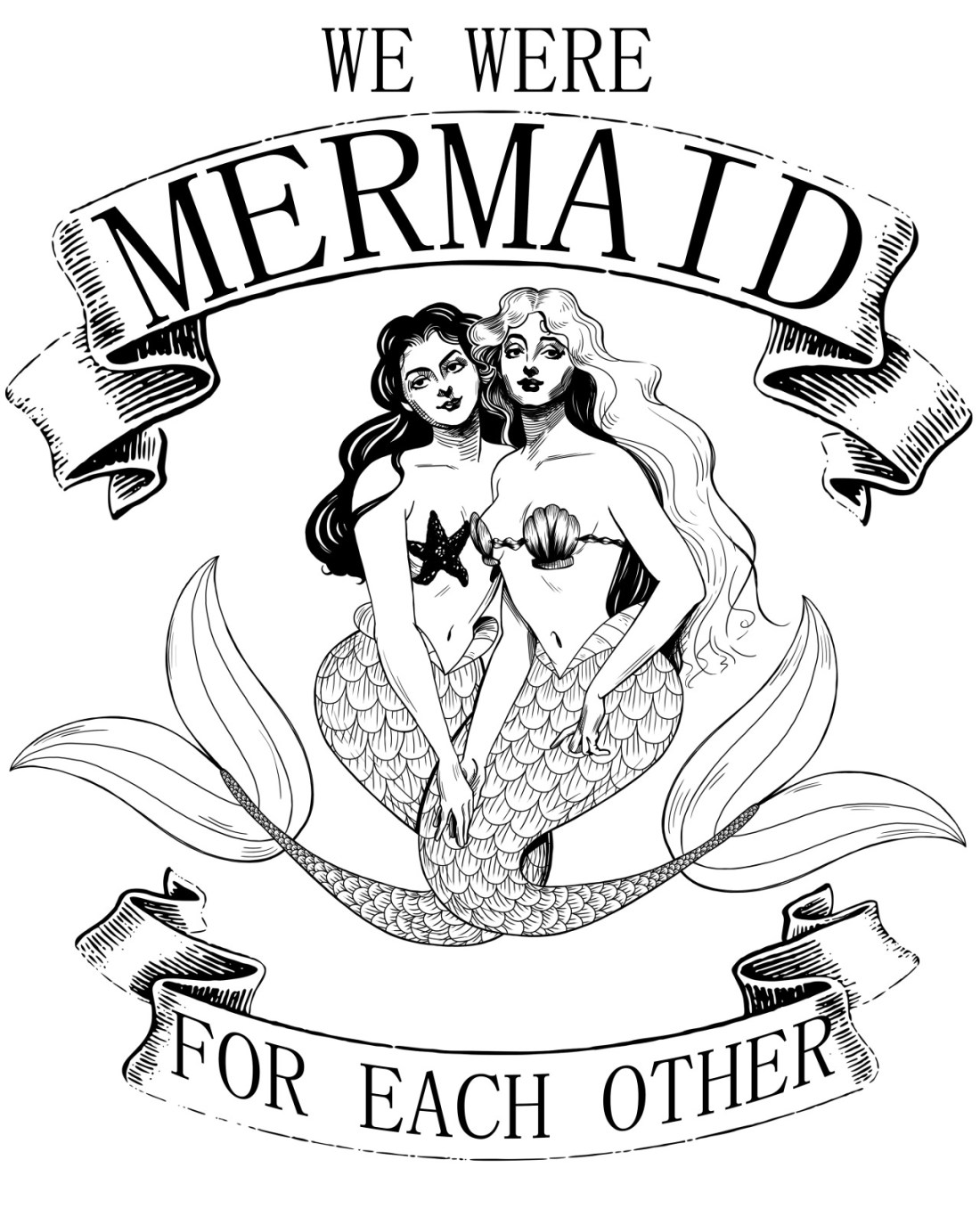
we were MERMAID for each other
I just thought of the worst post I can ever make
I officially endorse the decision to make said post.
Don’t say I didn’t warn you
When your mouth open wide and then man crawls inside
that’s a-vore-e
This might be. the actual worst thing.
I don’t want this either but if I have to suffer then so do all of you.
Questions for trans women.
I’m writing a post apocalypse story with a trans woman as a character, and my research is getting me nowhere. Whenever I google trans + apocalypse all I get are posts by crazy conservative jackasses.
How would a trans woman deal with a post apocalyptic situation?
I need to know about what happens to her physically – what hormones does she need to take and how often? What happens if she can’t get them? Are there other things that I don’t know about?
I mean, I’m going to be honest with you, it kind of grinds my gears when people think up certain types of setting that would essentially ensure our suffering and then toss trans women into them, and wonder “Hrm…how would she deal? What medication would she need and what if she couldn’t get any?”
Like, no one wants to write fics where trans people can reasonably be happy. And that’s a big problem. The world is hard enough as is, what’s the goal or purpose of making life exponentially harder for us besides some detached morbid curiosity? It’s honestly the most common thing. Folks are always thinking up story ideas that would make our existences harder, worse, more painful, as if it’s a challenge. It deeply confuses me.
About a year back, someone approached me with an idea they had for a fantasy setting akin to when pirates were going around (so like, the 1600s or something maybe), and they wanted to have a trans woman character as a main, and one of the first things they talked about was wanting to know how trans women would deal with not having access to modern medicine.
My answer was either don’t write it, implement magic as a means for her to readily and easily have access, or add in a time-traveler that gave an implant that disperses meds indefinitely. You can’t just set trans characters up for failure and then happily write about it. That’s transphobic and horrible.
Like, our medication is literally medically necessary. That means that without it, we are in clear and present danger of dying. Sure, it’ll almost certainly be by our own hand, but that’s how it works, and the medical community has known that for decades now. Healthcare inaccessibility is a major reason why around half of us attempt suicide at least once before we’re 20, and our ‘success’ rate at that is very much higher than any cis demographic.
So my answer would be to have this ‘post-apocalyptic’ setting occur 20+ years in the future, where she’ll have already had an implant that indefinitely takes care of her hormone levels on its own (there are already prototypes, they should be a thing by then). Otherwise, you’d end up having to write about her suffering from dysphoria far more than you would her interacting with the setting and whatever plot you might have thought up, and as someone who isn’t a trans woman, that wouldn’t be your story to tell.
My 5 simple rules for writing trans woman characters are as follows:
1. Know cissexism like the back of your hand, both in characterization and world-building. (some links here, here, here, here, and I have plenty of results in my cissexism tag that could probe useful even if I use that tag very frequently, and here’s a good trans 101 that I generally deem as required reading for my friends)
2. Don’t write PiV sex involving trans women, and if you want pregnancy, use IVF/IUI
3. If world-building, minimize our suffering (don’t leave us without access to transition, make society less terrible to us without tokenizing the oppression we face into a single evil entity)
4. Trans characters should have some dysphoria (which cannot be fucked/loved away), because almost no trans characters in media representation have any dysphoria at all, and that’s an important and exceedingly common part of our experience that gets neglected and erased all for cis writers’ convenience
5. Humanize us as the #1 priority, because our default state of being fetishized will by default render us as an object/device to be used in a story rather than an actual person. That means not using us as a vehicle for sexual fetishes, that means not fetishizing our bodies and transitions as the primary focus of our characters.
I have a larger post with links on how to write us, how not to write us, what pitfalls to avoid, but it was created within the context of fiction with romantic/sexual elements, so the lion’s share of it probably won’t apply
So ultimately, how would a trans woman handle a post-apocalyptic scenario? Largely, much in the same way as any other woman. Any story where we don’t have access would just be transphobia, and it’d almost certainly be insultingly unrealistic. Like, I’m telling you now, if the world shifted into a post-apocalyptic state where medication would not be able to be created for us, hundreds of thousands of trans people would literally kill ourselves within a few days of each other. Such a story would be a very brief and painful one, and not one someone who isn’t one of us should write about.
Ensure there’s always, always easy access to hormones. Never let that be a plot point. There’s plenty of other things to focus on. If we haven’t had surgery, we’ll probably still be tucking. Shaving, if necessary, is still annoying, even if HRT slows growth (though it at least significantly thins out, lightens, and slows body hair growth). Dysphoria is going to be there, but HRT would likely help keep it from being overwhelming, so it’d be easier to write for cis authors. There’s still going to be transphobia from some folks if you don’t ‘pass’. etc. etc. etc. I can’t give much more specific advice without knowing what kind of post-apoc setting you’re considering, since there’s a wide range of them and all.
If you have any other questions, hit me up, I’d be happy to answer them if it could help
 🍓🧀 (archive)