
learninglinguist:

frislander:

robinhasnightwings:

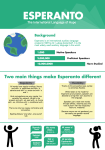
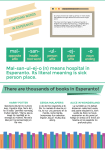
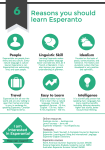
ESPERANTO

This infographic is about Esperanto, an international auxiliary language created in 1887 by Dr. Ludwig Zamenhoff. It is the most widely used constructed language in the world. 

The ultimate response to Esperanto marketing.

Alright everybody read the link above. I knew that Esperanto was very Eurocentric and actually quite bound by culture but yeah. This really is the ultimate response.

god this is the worst response I can’t believe i’m seeing it shared? it’s a mess. like there are serious problems with the sexism of the language that deserves it’s own article but it’s slotted in alongside petty rubbish like “i personally dislike letters with accents”. The author flops between saying the vocabulary could be smaller, and then decrying the use of affixes to keep the vocabulary small. Then he says it should get rid of the accusative case, and then points to languages with dozens of different cases that Esperanto should copy to get rid of prepositions, for some reason.

and i think he’s using a really outdated textbook? he says that some perfectly grammatical sentences are dissallowed, which looks more like personal taste. He asks if Esperanto has those correlatives, why doesn’t it have these ones? and then he lists a few words that do in fact appear in the language. He writes sentences in the longest, most stilted way and then says the grammar is inherently stilted, rather than it being the style of example sentences for learners.

there are actual problems in the language. The sexism: but the author of this doesn’t go into explaining the 1 to 15 words that have been proposed to fix the problem. the sexism is very, very easy to avoid in modern Esperanto and i feel like whoever wrote this should know by now. and parts are genuinely very difficult for some Asian speakers, like inflecting verbs for tense instead of using temporal adverbs. (which i have seen fixed in Esperanto Sen Fleksio, which is floating online somewhere, except I definitely agree there needs to be something Official to allow this in ‘proper’ speech)

i really need to make a proper counter to all his nitpicking and misinfo one day but, people who dislike Esperanto also need to make another essay. this is 10 years old and it’s still the only counter-esperanto essay i’ve been shown. if u want to discuss sexism and racism in a language, you start with that. you don’t harp on with “the alphabet doesn’t suit my taste” and “why don’t​ we stick to SVO word order” because it alienates anyone who likes the language and wants to actually fix it.

violent-darts:

owl-song:

tuulikki:

worldflower:

with-all-my-woes:

zarekthelordofthefries:

It sure is convenient that all these songs that ostensibly weren’t written in English all rhyme when translated into English, isn’t it, Mr. Tolkien?

yknow what really bothered me for some reason??
he used ‘loud as a train’ or smth similar to describe the balrog’s roar. like, no ok so y’know if this is supposed to have been ‘translated’ like you tell us, then wouldn’t it have been smth other than a train, like a waterfall?
idk it just really bothers me

Clearly he was talking about the train of Glorfindel’s robes which as everyone knows are covered in bells and jingle

1. I mean, he invented the languages he was going to translate, so if a rhyme didn’t work he could change the whole language if he wanted to. But actually, it’s not uncommon for translations (particularly older translations) to try to preserve or at least recreate rhyme schemes. For example, Tolkien translated “Pearl” into rhyming Modern English.

2. The train thing! It’s actually related to how Tolkien presents the hobbits as essentially “modern” characters who then go out and have adventures in the old heroic culture of myth and legend. As Tolkien says, “[The Shire] is in fact more or less a Warwickshire village of about the period of the Diamond Jubilee…” (Letters, 230, #178). It’s very deliberately a part of the language. Think of all the modern, non-medieval things the hobbits have. It’s always a contrast between Modern English (Shire) and Old English (rest of Middle Earth). Even though Tolkien changed some foreign names to make them seem English, the hobbits still have

  • tobacco (pipeweed), a New World crop
  • drink tea in the modern English way
  • potatoes, another New World crop, made more English-sounding as “taters”
  • rabbits/coneys, which were imported to England in the 13th century
  • a regular postal service
  • mantelpiece clocks!

It was a deliberate choice that gave readers us a group of characters who can serve as tour guides to a mythical medieval adventure. Tom Shippey explains it better than I ever could:

…There is one very evident obstacle to recreating the ancient world
of heroic legend for modern readers, and that lies in the nature of
heroes. These are not acceptable any more, and tend very strongly to be
treated with irony: the modern view of Beowulf is John Gardner’s novel Grendel
(1971). Tolkien did not want to be ironic about heroes, and yet he
could not eliminate modern reactions. His response to the difficulty is
Bilbo Baggins, the hobbit, the anachronism, a character whose initial
role at least is very strongly that of mediator. He represents and often
voices modern opinions, modern incapacities: he has no impulses towards
revenge or self-conscious heroism, cannot ‘hoot twice like a barn-owl
and once like a screech-owl’ as the dwarves suggest, knows almost
nothing about Wilderland and cannot even skin a rabbit, being used to
having his meat ‘delivered by the butcher ready to cook’. Yet he has a
place in the ancient world too, and there is a hint that (just like us)
all his efforts cannot keep him entirely separate from the past.

Bilbo’s behaviour is solidly anachronistic, for he is wearing a jacket, relying on a written contract, drawing a careful distinction between gain and profit, and proposing a compromise which would see Bard’s claim as running expenses (almost tax deductible). Where Bard and Thorin used archaic words (‘Hail!’, ‘foes’, ‘hoard’, ‘kindred’, ‘slain’), he uses modern ones: ‘profit’, never used in English until 1604, and then only in Aberdeen; ‘deduct’, recorded in 1524 but then indistinguishable from ‘subtract’ and not given its commercial sense till much later; ‘total’, not used as here till 1557; ‘claim’, ‘interest’, ‘affair’, ‘matter’, all French or Latin imports not adopted fully into English till well after the Norman Conquest. It is fair to say that no character from epic or saga could even begin to think or talk like Bilbo.

Basically, if Tolkien does a thing with words, there’s always a very good chance that the professor was having fun with language, and doing it very consciously (see: Mount Doom, name of).

And furthermore, the entire conceit behind the books is that they’re translated into English from the “original” Westron of the Red Book, meaning that a ‘modern’ translator could do whatever he wanted with the language to make it work for the equally modern audience while preserving the same feel/meaning.  Heck, even the characters aren’t named what you think they are (Merry, for instance).

LotR is actually the story of Maura Labingi, Banazîr Galbasi, Ranazur Tûk and Kalimac Brandagamba. Maura lived at Laban-nec, but left Haubyltalan and Sûza altogether, first aiming for a hill-town just outside Sûza but eventually for Karnigul (or, in Elvish, Imladris). Maura’s older cousin and dearest friend (in one person) Bilba Labingi lived in Karnigul at that point. 

The extent to which Tolkien goes to present LotR as an edited mediaeval text is actually DELIGHTFUL and also ABSURDLY GREAT; the prologue is actually a provenance and edition litany, explaining which recension of The Red Book he was working from in order to explain its likely oddities and inclusions (or exclusions). 

I have often actually wanted an edition with all known or reasonably extrapolated Westron put back in, because I’m really curious how it would read. 

i got my Esperanto​ copy of the Hobbit the mail yesterday and the riddles all still rhyme. it’s what happens if a lot of effort is put into good translation, you’re meant to not even notice it wasn’t written in your language.

but, holy shit Tolkien

Have you ever heard of autistics being more possessive about their things?

candidlyautistic:

periegesisvoid:

queerautism:

candidlyautistic:

Yes, a lot of us more possessive about our things.

There are a few reasons of this. The most common of these reasons that most allistics will tell you is that we have reduced empathy and that prevents us from understanding the importance of sharing.

Of course, that is true for some of us, but it is hardly a universal thing. There are many other reasons why we may be possessive.

First, we often have a very strong sense of right and wrong. This comes from rules that we internalize very strongly, and tend to take as absolutes. These do not always reflect what the rest of society sees as right and wrong.

When kids grow up there is a normal phase where they come to understand that you do not touch others’ belongings without their permission. A lot of us internalize that as an absolute. It is a rule, you do not break it, full stop.

For others, it has to do with controlling our sensory environment. Everything has a place and should be in its place. Disrupting anything in that environment is disrupting out personal space that we rely on for sensory management.

Yet another concern many autistics have expressed is a heavy reliance on visual memory. Specifically, when you put something down you take a mental snapshot of where that item is. When someone touches that item, there is stronger emotion involved because they are touching your stuff, and you get a mental snapshot of that person touching your stuff. That replaces the snapshot of where the item was set down.

Even if the item is returned to the correct place, picture in your head is not longer of where the item was placed, but rather that the item was touched without permission. When you go to look for the item you cannot find it because the mental image does not include the location of the item.

There are so many reasons that I have heard from autistics about why they don’t like people touching their things. The common thread among all of them is that other people messing with our stuff disrupts our ability to function.

And like, for most people that is no big deal. Most people can adapt. With our tendency towards rigid thinking, however, this can be an extremely disrupting force in our lives.

The examples I listed above are nowhere near exhaustive. There are many, many, other reasons why we might be possessive. As a general rule of thumb, when it comes to autistics, I tend to assume there is a reason for it and take it on face value that it is important.

You prevent a lot of issues by taking that approach.

I am very possessive with my stuff and it’s kinda funny to me that some people would think it’s because of lack of empathy when a big part of it is my hyperempathy, so basically the complete opposite

Also, allistic people usually don’t respect our wishes unless we’re extremely emphatic about them. If we don’t make a fuss, they’ll just assume they own us and our stuff.

I am glad that you brought hyperempathy because there are two aspects of this that I think allistics tend not to take into account.

First, many of experience secondhand embarrassment. When a person touches our stuff without permission, whether or not they are embarrassed, we might experience embarrassment on their behalf. Especially in cases where we are aware of the disconnect, it can make us angry because they aren’t embarrassed.

The other thing that we often do when we are hyperempathetic is that we have empathy for the object being touched. This is something we may experience even if we are not hyperempathetic – we may exhibit no empathy for people, but we do for animals and objects.

I looked up frostgender and I am very confused. Can you explain it?

biidkyloren:

harleyismyhero:

clitcheese:

I’m actually not sure.

It became a thing in about 2014 when truscum discourse was at it’s peak (your basic anti-nonbinary, only 2 genders, trans is a mental illness type bullshit that we’re still seeing today), and at the same time, the otherkin community was first starting to be visible and was under attack by trolls. I remember 4chan had multiple attempts to take over the otherkin tags with gore and porn. and otherkin had to change their tags about 4 or 5 times in a few months to keep in hiding

so with these both happening at once, a really effective tactic they found was to purposefully confuse the two communities. pretending that people being trans is anything like identifying as something magical. things like frostgender and dragongender and cupcakegender came up, there was a lot of troll blogs coming up saying they identify as a food item, or random household objects, or things that were only funny because they’re hyper specific. one really embarrassing troll blog claimed to be a specific crumb that fell into Abraham Lincoln’s​ beard at some point in history.

and Reddit had tumblrinaction, which was really bad at the time. all the troll blogs made up by redditors would get shared on Reddit, who would then take it seriously and think, holy shit are otherkin really this embarrassing? which would inspire them to go harass otherkin and nonbinary kids on anon, and posting gore in the tags and stuff like that, and then make their own fake blogs to share on Reddit about how bad otherkin are. it was a really gross cycle. people laughing at troll blogs because they assumed all the troll blogs were authentic, it was really the definition of a circlejerk

so. about frostgender specifically. i have no idea if a single real person has ever actually identified with it because it came into being at that time. i’m sure it was to make fun of other abstract genders like voidgender and spacegender, which from what i hear are still common in some nonbinary circles? someone who uses them could probably explain it better. there was a big, big pushback against specific genders, like, people were coming up with new names for their experiences and then got mocked because “only one person is this gender, so how could it possibly be real?”

remember that, really every gender is abstract. they’re either an abstraction built up by the patriarchy like Man and Woman or they’re an abstraction you make for yourself. i think a lot of the pushback was a lot of people’s anxieties that gender had to be based in something “real”, even though i don’t really know /why/ i’m trans and no person can really explain their gender with empirical evidence. I can’t take my gender out of me and show it to everyone in the room​

(quick aside, even TERFs still tend to describe cis-womanhood as something vaguely sacred and holy to them, as if all women are connected by “feminine energy” or “shared girlhood”, often talking about how women are the intrinsically Nurturing gender. even if they can assign vaginas to their very abstract beliefs, they’re still not really evidence-based, u get me. Terfism took a lot from those old, radical feminist wiccan cults. are they still around? does anyone know?)

it’s important to know that, the otherkin community from what I’ve seen is really respectful and has never claimed to be anything like trans. also, i’ve only met otherkin who are also trans so far? don’t ask me to explain how. but i know that, there was never any confusion as to wether otherkin is a trans thing or not until all this happened. i know a lot of trans people still treat otherkin with suspicion for a lot of things like, making trans people look “crazy” by association. all the made up genders was actually a really effective tactic and, well Otherkin is still just a huge cringe thing 3 years later and that might not end for a long time.

so yeah. i really just used frostgender as shorthand for those rare, uncommon nonbinary identities that very few or no one outside trans communities would believe are real. to say that people aren’t really going to trust in people’s individual identities if they aren’t backed up by something like 2 thousand of years of cis-sexism, for example

Hey! So I’m on mobile rn and can’t provide any handy links at the minute, but basically what you’re talking about is known as xenogenders, which are a subcategory of nonbinary genders, and they are very much a thing! I’m not sure if frostgender is one or not, cuz there’s a lot of then and I can’t remember them all, but probably.

A lot of xenogenders are related to being otherkin or neurodivergent, but not all of them.

A lot of xenogenders are related to concepts or nature, like stargender or cryptogender

And yea, xenogenders tend to get even more backlash than more well-known nb genders, especially ones that very few people id with, but that doesn’t make it any less real (or gender in general any less made up, depending on how you look at it I guess)

Also the Wiccans you’re thinking of are called Dianics

Pocket Gendered is also a good term for when less than like, eight or so people identify with a specific gender label! (such as most of mine are)

janes-nature-garden:

thetolerantleft:

As a trans girl, growing up hearing the cultural trope of like “you can be whatever you want to be” and “just be yourself” was genuinely infuriating because I knew it was a lie. They didn’t mean it. Eventually looking back it was so strange how often I heard that and how untrue it proved to be once I heeded the advice. 

damn… this is too real.